
On May 14, 2026, the Government of Canada launched a consultation on a new national electricity strategy, publishing Powering Canada Strong: A National Strategy for an Electrified Canadian Economy (Powering Canada Strong). The consultation was announced by Prime Minister Mark Carney, stating “This plan will double the capacity of our grid by 2050 and supply clean, reliable, affordable power across the country for decades to come. To develop this strategy […] we are launching consultations with provinces, territories, Indigenous Peoples, utilities, and unions. Over the next few months, we will work together to identify the actions needed to double our grid most effectively and affordably.”
The Prime Minister indicated that the strategy would be guided by four pillars:
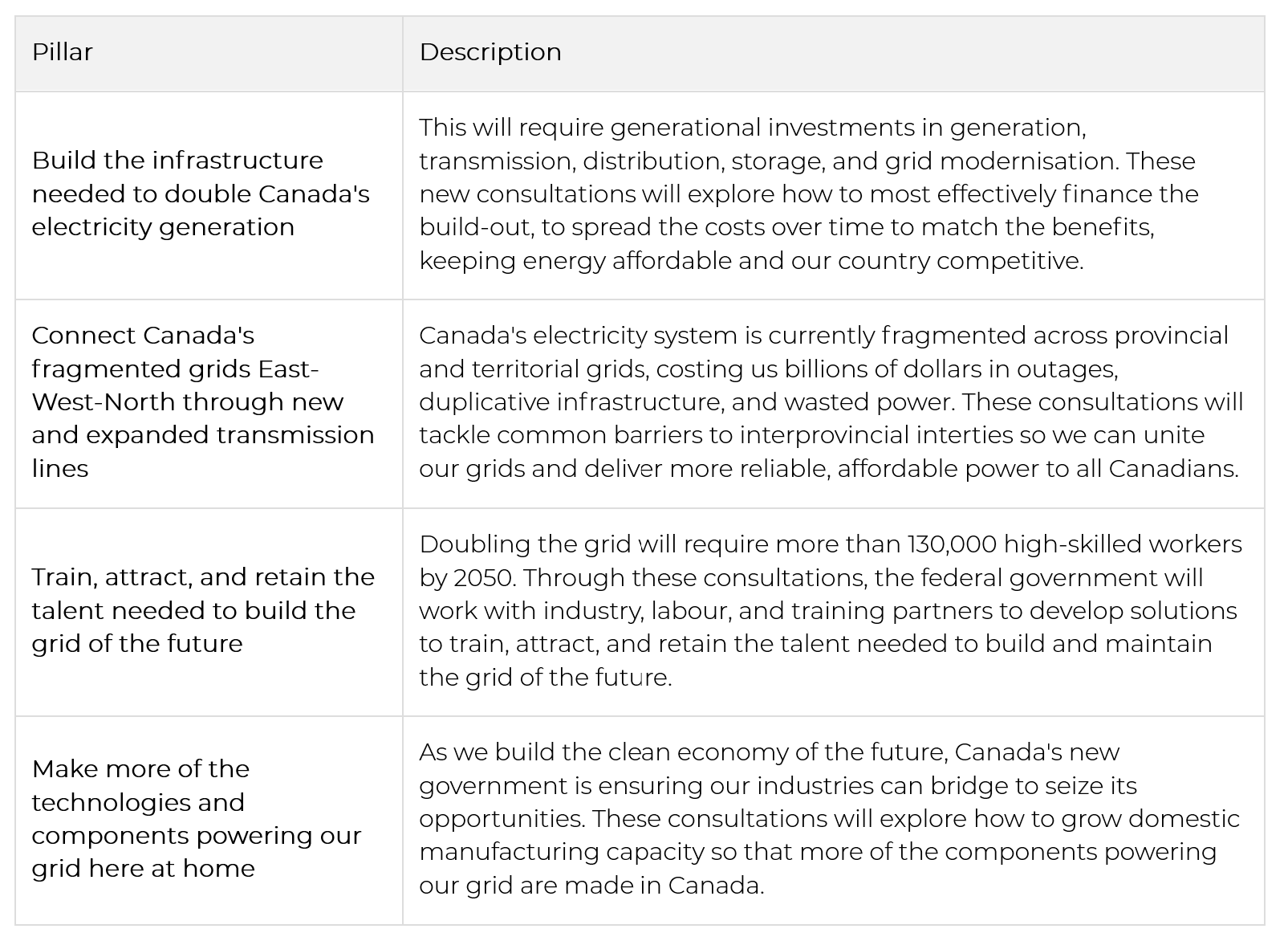
Prime Minister Carney also announced that the federal government would be “expanding support for energy-saving retrofits for up to one million households through financing, grants, and complementary measures,” including measures to facilitate households to switch from propane, oil, and electric baseboard heating to electric heat pumps.
Additionally, the Prime Minister indicated that “[t]o build more transmission intertie projects specifically, we will refer the development of a new comprehensive Transmission InterConnect Investment Strategy to the[Major Projects Office].”
The Powering Canada Strong consultation paper contained further details, indicating that the government was seeking “to determine how it can bestwork with provinces, territories, and other partners to expand efforts” through receiving input in eight areas:
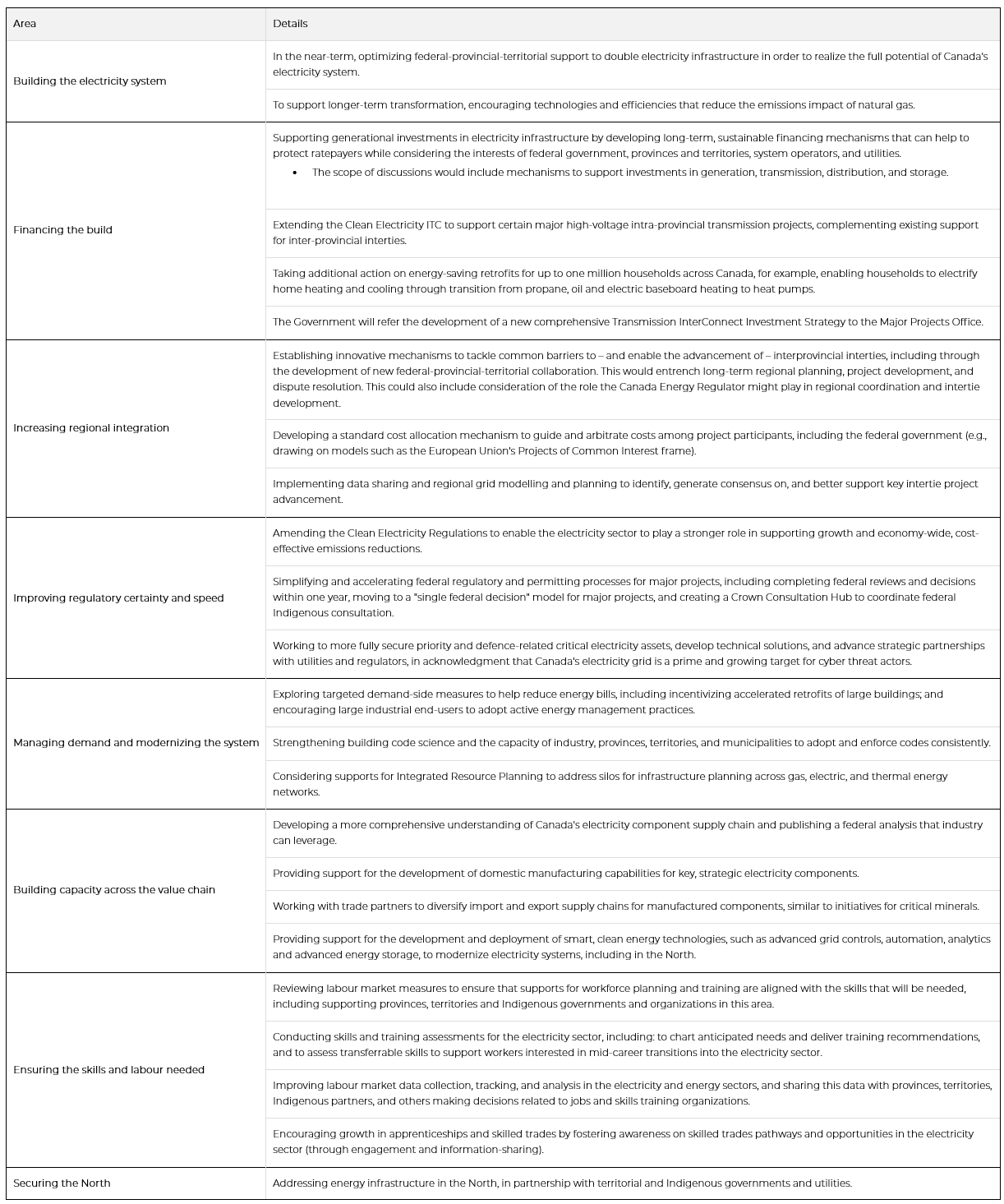
Commentary
Power Advisory has previously noted (here and here) that countries around the world have concluded that it is essential to achieve energy independence and security in order to achieve economic security and independence. Canada is no exception. As seen in the summary tables above, the consultation document is vast in scope, covering the entire electricity system, including generation, transmission, distribution, storage, end-use fuel-switching, energy efficiency, workforce, energy management, supply chain, and grid modernisation. Taken together, Powering Canada Strong and the Prime Minister’s announcement represent Canada’s most clear and detailed articulation of a national strategy for addressing a volatile geopolitical environment, as well as meeting future energy needs (particularly through electrification of many sectors of the economy) to fuel economic growth in an expedited, stable, secure (both physical and cyber-related), reliable, resilient, and affordable manner.
Overall, the primacy of economic security, competitiveness, affordability, and sovereignty are made early and repeatedly throughout Powering Canada Strong through such statements as “[a]ccess to abundant, affordable, and reliable electricity is – more than ever – fundamental to competitiveness, energy security, and economic sovereignty […] Given the increasingly uncertain global environment, we must bolster reliable domestic energy supply to strengthen Canada’s sovereignty and economic stability.” Similarly, Prime Minister Carney’s announcement states “[e]lectricity is the clear solution to Canada’s energy security, affordability, and competitiveness.”
Moreover, these themes drive the direction of many significant policy proposals throughout the consultation paper, especially with respect to electrification, the role of natural gas, and the Clean Electricity Regulations (CER). For example, it is indicated that Canada will pursue “strategic electrification,” and that “emissions from end-uses like transport remain far higher than those from electricity generation and represent the largest opportunity for cost-effective reductions.” This is followed by recognition of the importance of natural gas generation “in supporting reliable, affordable, and secure electricity systems in Canada,” and that “Canada’s abundant and dependably low-cost natural gas resources help enhance energy security and system resilience, while limiting exposure to global supply disruptions in many regions. In doing so, natural gas can contribute to system stability and affordability, while also contributing to cost-effective emissions reductions.”
Further, with specific reference to the CER, the paper states that “the global context has changed, and Canada faces new and urgent pressures and threats. An evolved approach is required. In this context, the Government of Canada intends to adjust the [CER] to enable the sector to grow more rapidly across all provinces and territories by providing greater flexibility to offset residual emissions elsewhere. This will make mass electrification and the cost-effective emissions reductions it delivers an even larger part of the Government’s climate and economic strategies, by leveraging the electricity sector to deliver even more emissions reductions.” This change in approach appears aimed at addressing the reliability and operability challenges of the current CER that have been raised by Balancing Authorities (i.e., public utilities and system operators within each province) across the country. The Independent Electricity System Operator in Ontario, for example, has repeatedly highlighted its concerns regarding the impact on the province’s grid due to CER-related constraints.
The same reasoning applies to the federal government’s desire to aggressively support the development of greater transmission interties between provinces (including “[d]eveloping a standard cost allocation mechanism to guide and arbitrate costs”) with the paper noting that increasing regional interconnections will “enhance resiliency by pooling resources to offset shortages during peaks, outages, or extreme weather […] take advantage of geographic and time zone differences to allow for better load balancing […] lower costs by avoiding the need for each province and territory to invest in duplicative or redundant capacity builds [and] bolster energy sovereignty and security, including amid rising demand.” For example, the plan notes that the transmission and non-emitting generation (on- and offshore-wind, nuclear, and hydro) related to the Atlantic Energy Strategy could “meet rapidly growing demand across Eastern and Atlantic Canada and beyond.”
Another noteworthy component of Powering Canada Strong is the approach to funding the enormous infrastructure modernization and expansion, estimated to cost over $1 trillion between now and 2050, contemplated by the government. The paper states that “the scale of investment required demands consideration of the appropriate balance between ratepayer and taxpayer contributions— both today and over the decades ahead — and how to best protect affordability for Canadians.” However, it then goes on to state “[m]anaging the affordability challenge also means that the current generation should not have to bear an unfair burden in shouldering the upfront investments for electricity system costs that will deliver energy to future generations. Appropriately structured financing can help ensure that the benefits of electrification and its costs are fairly distributed across the generations.” It remains to be seen how the government will address this challenge of balancing costs between public and private financing (the paper mentions a role for institutional investors such as pension funds), ratepayers and taxpayers, and current and future generations. However, it is clear that acquiring the massive amount of capital needed to build out the system as well as managing the resulting costs to ratepayers (and taxpayers) will not be easy and represents a practical barrier to executing the government’s proposed infrastructure expansion strategy.
Also, Powering Canada Strong proposes an extremely ambitious degree of coordination and cooperation among regions, governments, regulators, system operators, utilities, industry, and communities that has not been required previously. In particular, with respect to cooperation and interties, the proposal recognizes the need for a “development of new federal-provincial-territorial collaboration,” as well as examining the role of the Canada Energy Regulator. Achieving greater collaboration would certainly be a welcome outcome; however, it will necessitate navigating the complex and often tense political landscape involving jurisdiction over energy and environmental matters between the federal government and provincial and territorial governments. History suggests this will be an extremely challenging task.
Taken as a whole, Powering Canada Strong provides serious federal leadership on electricity infrastructure at an opportune time. With provinces and territories advancing major energy plans currently, having the federal government come forward with proposals that clearly identify energy as a national priority creates a uniquely favourable environment of aligned political will. This alignment of interests bodes well for enabling significant electricity infrastructure investment across Canada.
Power Advisory strongly advises clients and interested parties to read Powering Canada Strong in detail given the scope of the document and the opportunity to provide feedback. While the consultation paper does not indicate a deadline for comments, media reports indicate that the government will seek to finalize the strategy over the next four months.
Please contact Power Advisory if you require any assistance with making submissions as part of the consultation process, have any questions, or would like any additional information.