
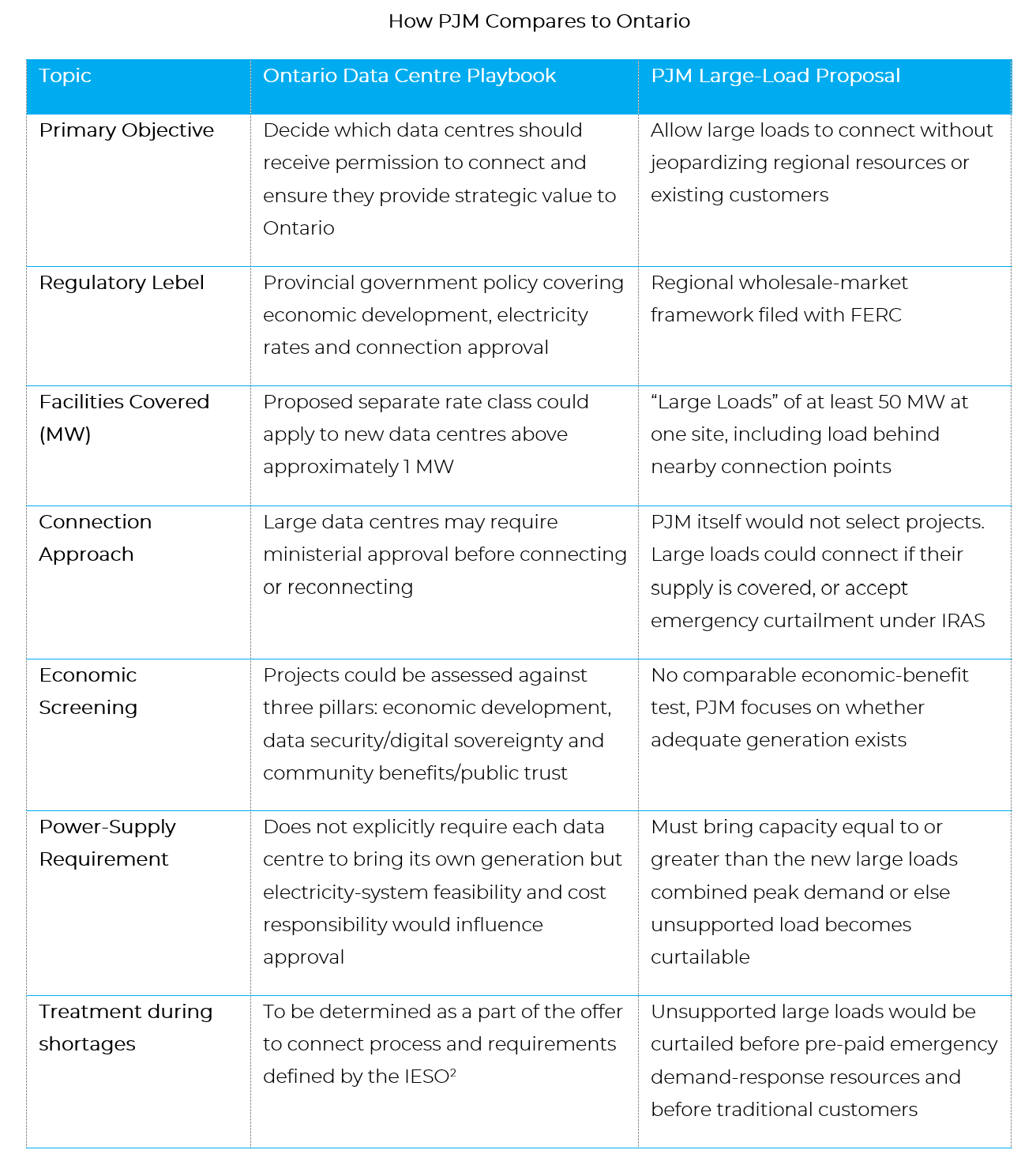
On August 13, 2026, Ontario (Companion article: Ontario Launches Data Centre Playbook) and PJM each released a proposals responding to rapid data centre growth. The timing was coincidental; the policy contrast is not. Both are trying to protect reliability and existing customers, but they are using different regulatory levers.
Ontario is proposing to decide which data centres represent a sufficiently valuable use of scarce grid capacity, whereas PJM is proposing to let large loads connect if their power needs are supported, or make them interruptible when supply becomes scarce.
Same problem, different governance: Ontario proposed Data Centre Playbook [1] would combine a strategic assessment with an electricity-system impact assessment, supported by a new Global Adjustment rate class and a principle of full-cost responsibility.
PJM is a US federally regulated regional transmission organization spanning 13 states and Washington, D.C. It operates wholesale electricity markets and coordinates the regional grid, while states and utilities retain important authority over retail service and cost allocation. PJM therefore cannot simply reproduce Ontario's model of ministerial project selection.
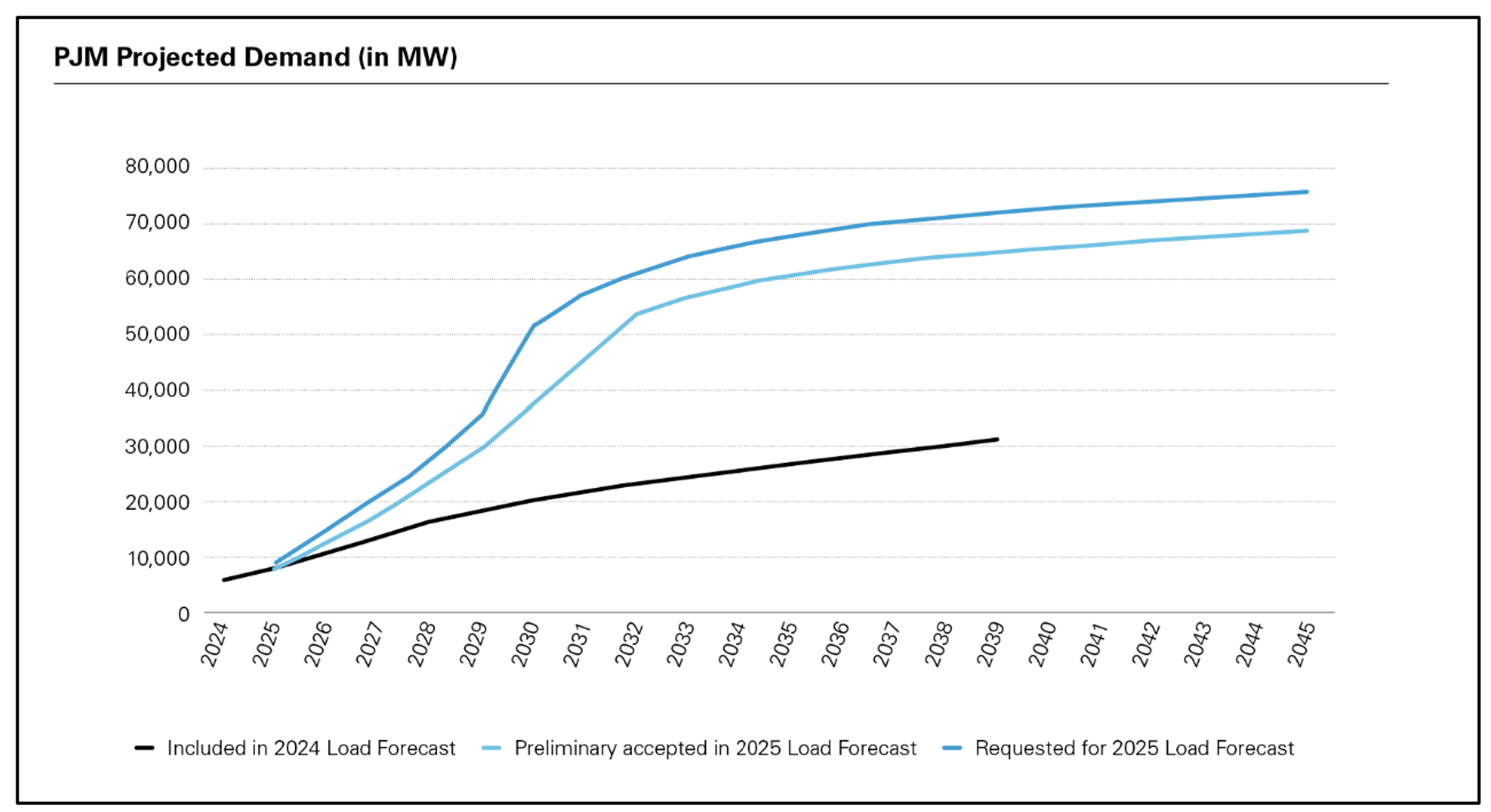
The scale of PJM's demand growth explains the urgency. PJM attributes 30 GW of the 32 GW increase in forecast electricity demand between 2024 and 2030 to data centres. PJMs response has been a package of reliability, planning and generation-supply measures.
PJMs Proposed Large-Load Framework: PJM's proposal is the Interim Resource Adequacy Service (IRAS), filed with the Federal Energy Regulatory Commission (FERC) on August 13, 2026. (At the time of this article, the proposal remains subject to FERC acceptance.) Key elements of the proposal include:
WHAT THE COMPARISON MEANS FOR DEVELOPERS AND TENANTS
First, 'bring your own power' is becoming a commercial strategy, not a slogan. In Ontario, generation and storage may strengthen the strategic and technical case for approval. In PJM, sufficient new supply can determine whether a large load is firm or exposed to curtailment under IRAS.
Second, power quality and power firmness must be separately. A PJM site may have a path to interconnection but still carry an emergency-curtailment obligation. Developers and tenants should confirm whether the load is registered, how its capacity needs are being supported, who bears the curtailment risk and whether backup generation can sustain the contracted service level.
Third, thresholds matter. Ontario is introducing a new data center rate class “Class C” threshold above 1 MW, while PJM's proposed Large Load framework begins at 50 MW. The difference reflects the policies' different purposes, but it could also shape campus phasing, account structures and competition between existing and new facilities.
Finally, neither framework offers a cost free shortcut to power. Ontario is proposing strategic screening, a separate GA treatment and full-cost responsibility. PJM is pairing a path to connection with new supply obligations, planning treatment and curtailment risk. In both markets, the developer's electricity strategy is moving from technical due diligence to the centre of the business case.
Ontario is asking which data centre projects merit access to scarce grid capacity. PJM is asking how large loads can connect without leaving existing customers with an unfunded reliability obligation. Those are different questions, but they lead to the same practical conclusion: a credible project now requires more than land and a connection request. It requires a defensible plan for supply, cost and system impact.
[1] https://ero.ontario.ca/notice/026-0853[2] https://www.ieso.ca/Sector-Participants/Engagement-Initiatives/Engagements/Technical-Requirements-for-Large-Computational-Loads-Connecting-to-the-Ontario-Power-System