
On June 18, 2026, the IESO released its latest Reliability Outlook (“Q2 2026 Reliability Outlook Seasonal Update”) forecasting inadequate supply in April 2027 (two consecutive weeks) under “expected” weather conditions. The report acknowledged that the supply shortage will be managed by “shifting planned outages”. The IESO added that “Market participants are advised to avoid any planned outages during this time”. Historically, facilities would plan outages in April, as it is a “shoulder period” for demand between the peak winter and summer months (i.e. a low demand season).
The Reliability Outlook also noted that this year’s peak demand could reach “close to 26,000 MW” under extreme weather conditions, higher than the 2025 peak of 24,775 MW that was the highest in the past 12years. And finally, the latest Reliability Outlook has made a change to non-firm imports during the summer period for the first time:
"Tightening grid conditions across the continent have led the IESO to re-evaluate its import assumptions. Based on import availability over the past year, forecasts will now assume up to 1,800 MW can be depended on, reduced from the previous assumption of 2,000 MW for the summer period. While all jurisdictions rely on imports to varying extents, Ontario has been an increasing net exporter in recent years, reflecting its relatively strong reliability position."
This adjustment is aligned with the new Reliability Outlook methodology, which states “Events that reduce Ontario’s ability to import power such as outages on interties, internal system constraints, and conditions of neighbouring jurisdictions will be considered, and the import assumption is adjusted accordingly between zero and two thousand megawatts”.
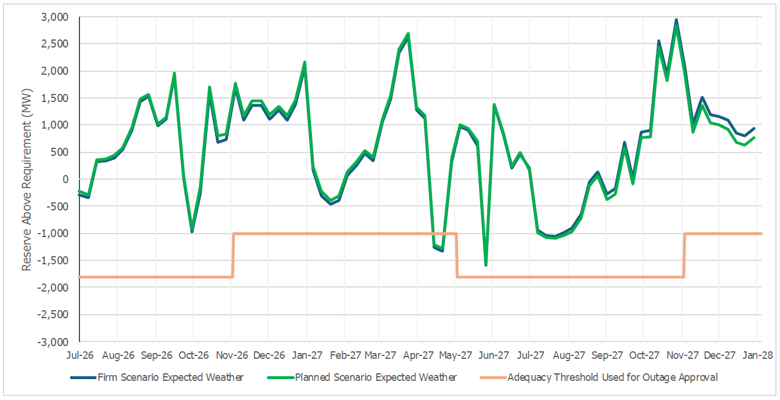
The June 2026 Reserve Above Requirement under expected weather, for both the planned and firm scenario, is reproduced below. The Reserve Above Requirement (RAR) is the difference between Available Resources and Required Resources. The “firm” scenario includes higher certainty resources online during the period whereas the “planned” includes lower certainty resources. As shown below, the RAR falls below the threshold used for outage approval by the IESO.
The Reliability Outlook was recently streamlined by the IESO, as detailed in two stakeholder engagement presentations in 2025.
Power Advisory Commentary
The IESO has consistently provided updates and data relating to the Reliability Outlook. As system conditions begin to shift, additional insights into the methodology would be welcome. Two new elements in the most recent Reliability Outlook would benefit from additional information:
Regarding the potential shortage in April 2027, it should be noted that it may not materialize and could even be reduced or eliminated in the next Reliability Outlook. The concern remains that, should there be a legitimate event forecast with inadequate supply, a better understanding of the actual quantities relating to available IESO mitigation efforts should be signalled to the market as early as possible.
In terms of the adjusted summer import reduction, noting that multiple factors could have led to this reduction, the IESO could provide a more descriptive explanation that identified which factor led to the decrease, and why. In addition, a more detailed section in the Reliability Outlook methodology would be beneficial to know more about the underlying methodology that resulted in the reduction of imports.