
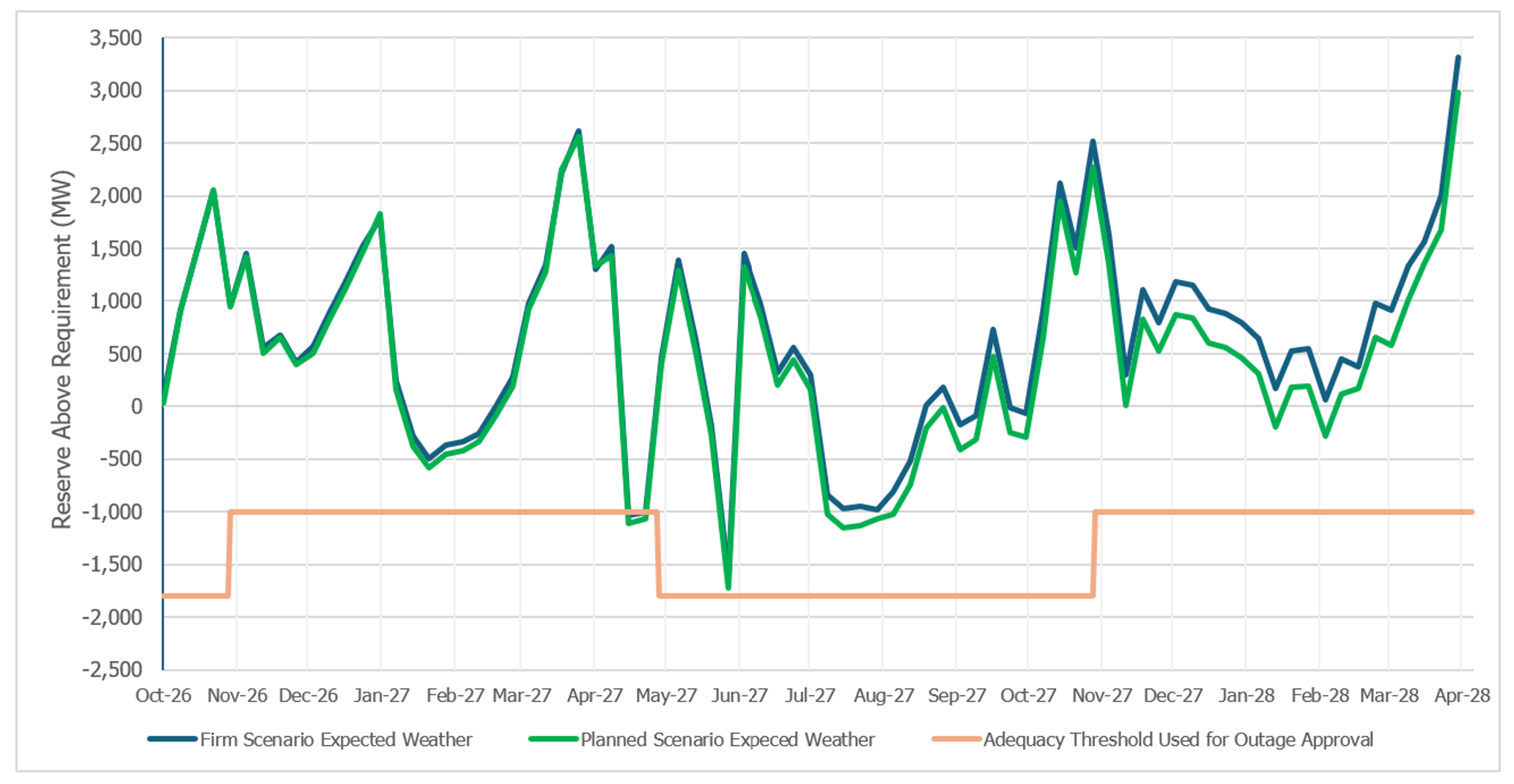
Ontario’s supply/demand balance is continuing to tighten, according to the IESO’s most recent Reliability Outlook data (“Q3 2026 Reliability Outlook”), with the latest Q3 data continuing to show that the province’s grid will have inadequate supply in April 2027 for two consecutive weeks under expected weather conditions. The Q3 Reliability Outlook supports the previous Q2 Reliability Outlook that also forecasted multiple weeks in April where the reserve margin was below the adequacy threshold used for outage approval. The Reliability Outlook also shows tighter conditions for the final week in May 2027 compared to the previous outlook.
Historically, facilities plan outages in April, as it is a “shoulder period” for demand between the peak winter and summer months (i.e. a low demand season). April 2027 is expected to have reduced nuclear capacity, due to nuclear refurbishments – Pickering B units are already starting to come offline – and there is a planned Vacuum Building Outage (VBO) at Darlington that will shutter the facility for up to seven weeks. The seven-week period in April will result in more than 7,200 MW of nuclear outages. At the same time, between 3,600-3,800 MW of gas facilities [1] are also planning to be offline for the four weeks of April 2027.
This seasonal interim Q3 Reliability Outlook provides updated data only, without an updated report. The IESO has released an updated “Methodology to Perform the Reliability Outlook” along with the updated data. The updated methodology does provide some additional context relating to the Reserve Above Requirement (RAR), which measures the amount of available supply compared to supply needs. With the RAR threshold import assumption for summer recently lowered from 2,000MW of non-firm imports to 1,800MW, an updated table is presented in the methodology, with the following explanation:
The thresholds were informed by expected future non-firm import capability and historical observations from periods of stressed system conditions, including periods characterized by elevated market prices and periods associated with alerts, such as the IESO Capacity Margin Alerts (CMAs) and Energy Emergency Alerts (EEAs).
The September 2026 Reserve Above Requirement under expected weather, for both the planned and firm scenario, is reproduced below. As noted, the Reserve Above Requirement (RAR) is the difference between Available Resources and Required Resources. The “firm” scenario includes higher certainty resources online during the period whereas the “planned” includes lower certainty resources. The Reserve Above Requirement is allowed to drop below 0 MW, as it can rely on non-firm imports and other measures to meet the adequacy threshold. The RAR can therefore be negative while still meeting the adequacy threshold, as long as it is above the threshold that includes non-firm imports assumed for winter (-1,000MW) and summer (-1,800MW). As shown below, the RAR continues to fall below the threshold used for outage approval by the IESO in April 2027.
Power Advisory Commentary
As we enter into a period of more limited nuclear availability and increased utilization of the gas fleet, market prices are expected to rise, activations of Demand Response and other load programs are expected to increase and planning for gas generator outages will become more difficult to manage.
Ontario typically experiences hours of low-cost supply in April, driven by contributions from hydro (depending on freshet), nuclear and wind generators (i.e. all zero or low marginal cost resources). The reduced nuclear availability in spring 2027 will limit the amount of lower marginal cost supply – replacing it with higher marginal cost options such as gas-fired generation or imports. Unless freshet conditions lead to more hydro generation than anticipated – and even then, transmission constraints may “bottle” some of this supply in the Northeast and Northwest zones – the reduction in nuclear supply is likely to lead to increased gas generation. The expected increase in gas generation would build on the record gas-fired generation in 2025 – with the 2026 year-to-date gas fleet output tracking about 20% higher than 2025 year-to-date. With increased gas outages occurring in April, the market price when gas is the marginal resource would be pushed higher than it otherwise would be under historical conditions in Ontario. This effect is likely to occur most materially during off-peak hours that would otherwise benefit from the lowest load levels being met mostly by baseload nuclear, wind and run-of-river hydro.
The Reliability Outlook reflects a forecast of Ontario’s system adequacy without considering the impact exports have on market demand, as this is beyond the scope of the study. Ontario has been a net exporter of between 1,200 MW and 2,900 MW on average each hour during the month of April from 2020 to 2026, heavily influenced by hydro generation and freshet. Although neighbouring systems are also experiencing periods of low demand during April, interties are typically supporting lower regional prices than they otherwise would be, with net exports from Ontario reflecting higher market prices elsewhere, in grids typically dominated by thermal resources. With low levels of nuclear availability coupled with high amounts of gas facility outages during April 2027, the intertie flows could experience less exports and more imports for Ontario.
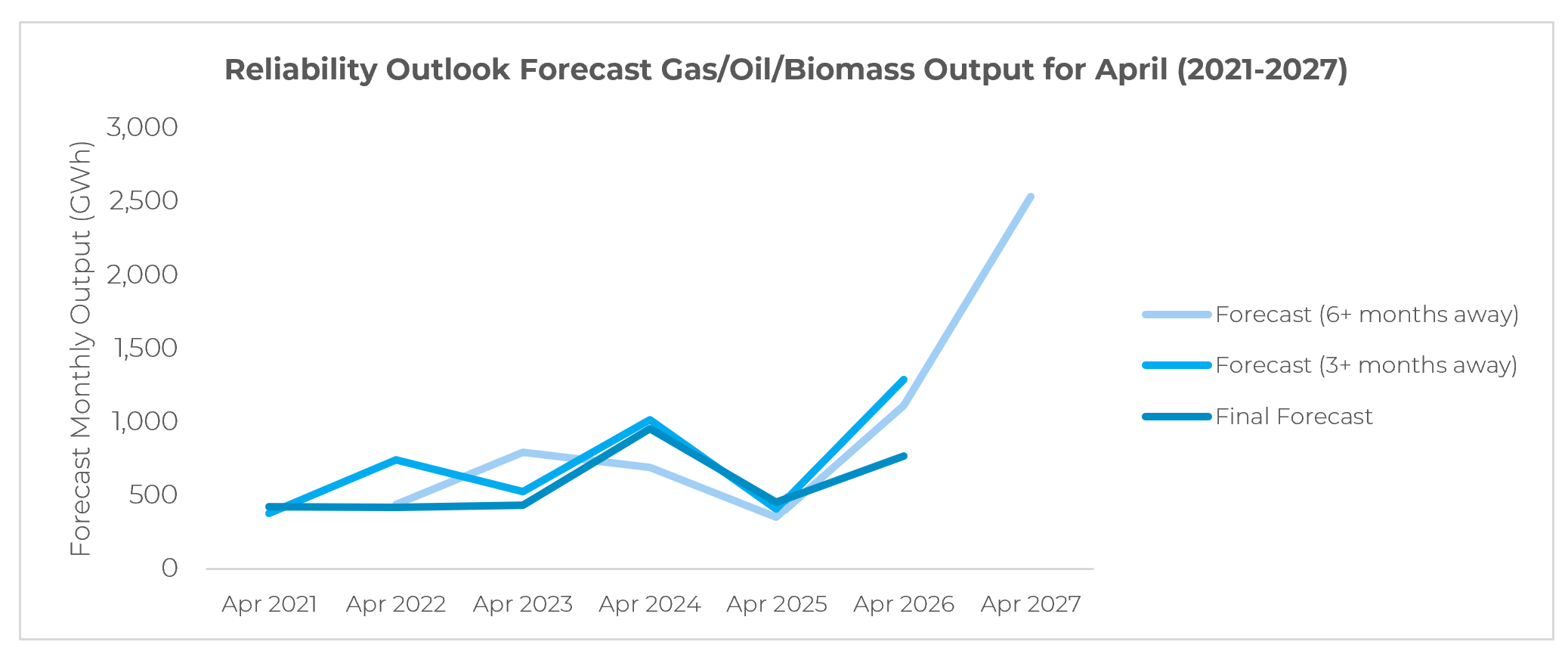
The forecast Reliability Outlook data for gas, oil and biomass generation for the month of April is shown below, between 2021 and 2027, for the forecast periods in relation to how far in advance the forecast was made (final forecast reflecting 0 to 2 months, 3+ months reflecting 3-5 months, etc.). The latest Reliability Outlook data is forecasting gas output to increase to 2.5 TWh for April 2027, to account for reduced nuclear availability. This is materially higher than previous outlooks have forecast from gas output during April, as shown in the graph below.
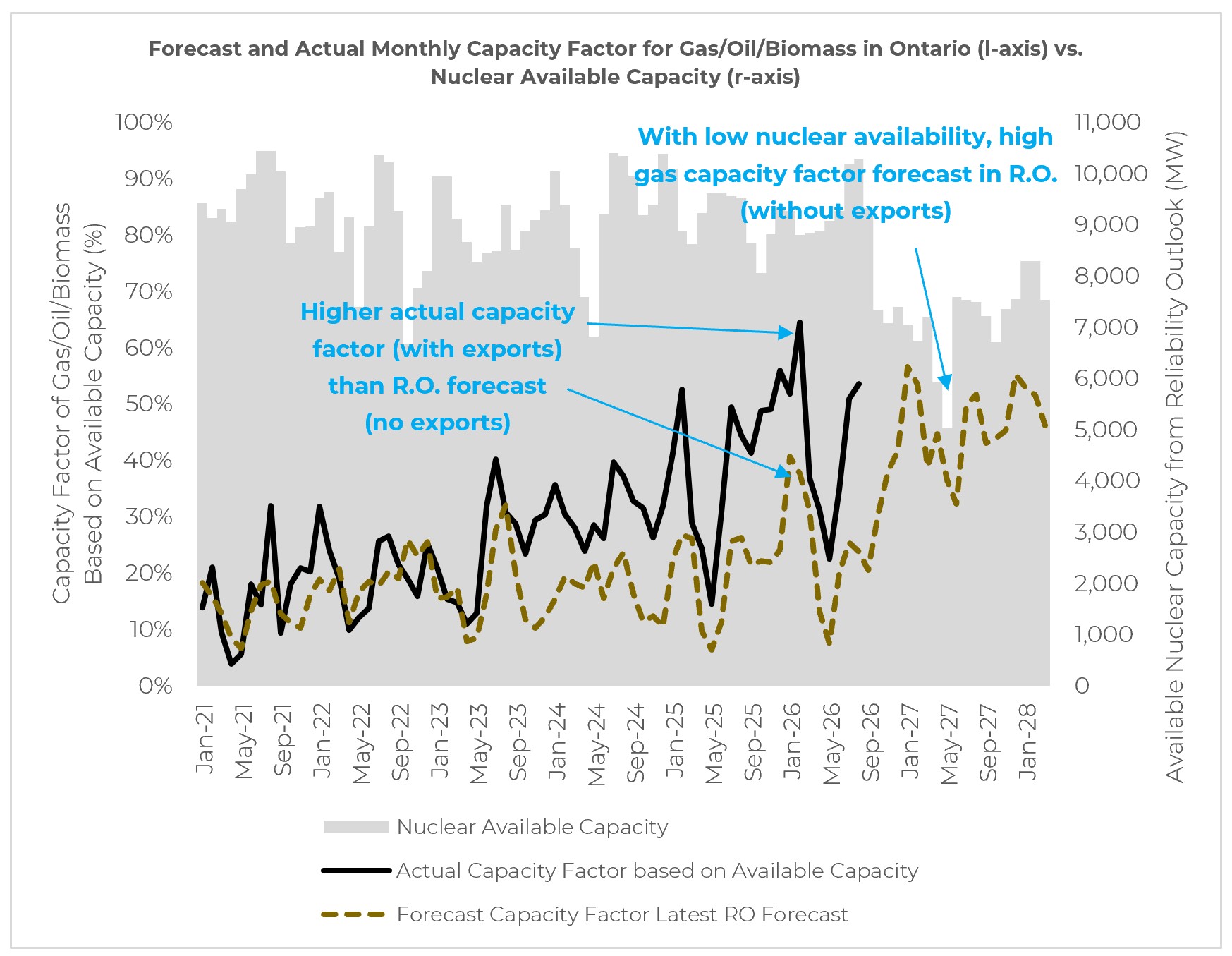
Between 2021 and 2026, the highest actual gas, oil and biomass output in April was 1.8 TWh in April 2026. To reflect the available capacity and output of the gas/oil/biomass fleet during the month of April compared against other months, using the capacity factor based on available capacity provides an indication of how much of the gas fleet is utilized in a given month. The monthly capacity factor of the gas/oil/biomass fleet would provide a clearer indication of the influence on the market price than the energy output.In the graph below, the forecast monthly capacity factor for gas/oil/biomass from the Reliability Outlook (reflecting Ontario demand) is shown, with the actual monthly capacity factor (reflecting market demand) also shown frequently exceeding the forecast, due mostly to the inclusion of exports. The available nuclear capacity is overlaid against the steadily increasing capacity factors forecast for the gas/oil/biomass fleet, showing the combined effects on the tighter supply conditions in April 2027.
While there is likely to be upward pressure on market prices in April 2027, it is still possible that there will be sufficient reserves above the planning threshold, as there remains six months to go before spring. Should supply and demand levels remain as forecast, the IESO will still have a planning reserve of resources available for April 2027 just slightly under where the IESO’s reliability standards would ideally plan for, during a period of regional low demand. Regarding the amount of nuclear capacity offline for the seven-week period, the work at Darlington may be completed ahead of schedule, as they are heavily incentivized to do so. This could limit the impact of the tighter system conditions forecast at the end of May but would not impact the lower reserve forecast in early April.
[1] Mainly gas would be represented in IESO’s “Gas, Oil & Biomass” grouping in the Reliability Outlook.