
Summary
On November 24, eleven owners of community solar projects in Maine – representing a combined 111 projects totaling 415 MW – filed a federal lawsuit against the State of Maine challenging LD 1777, a law enacted in June. The law retroactively imposes monthly fees on certain kWh Credit Program projects and shifts Tariff Rate projects from variable compensation to a lower rate with a fixed annual escalator. The plaintiffs argue that these changes violate constitutional protections for contracts and property, and are seeking a preliminary injunction before the new charges take effect on January 1, 2026.
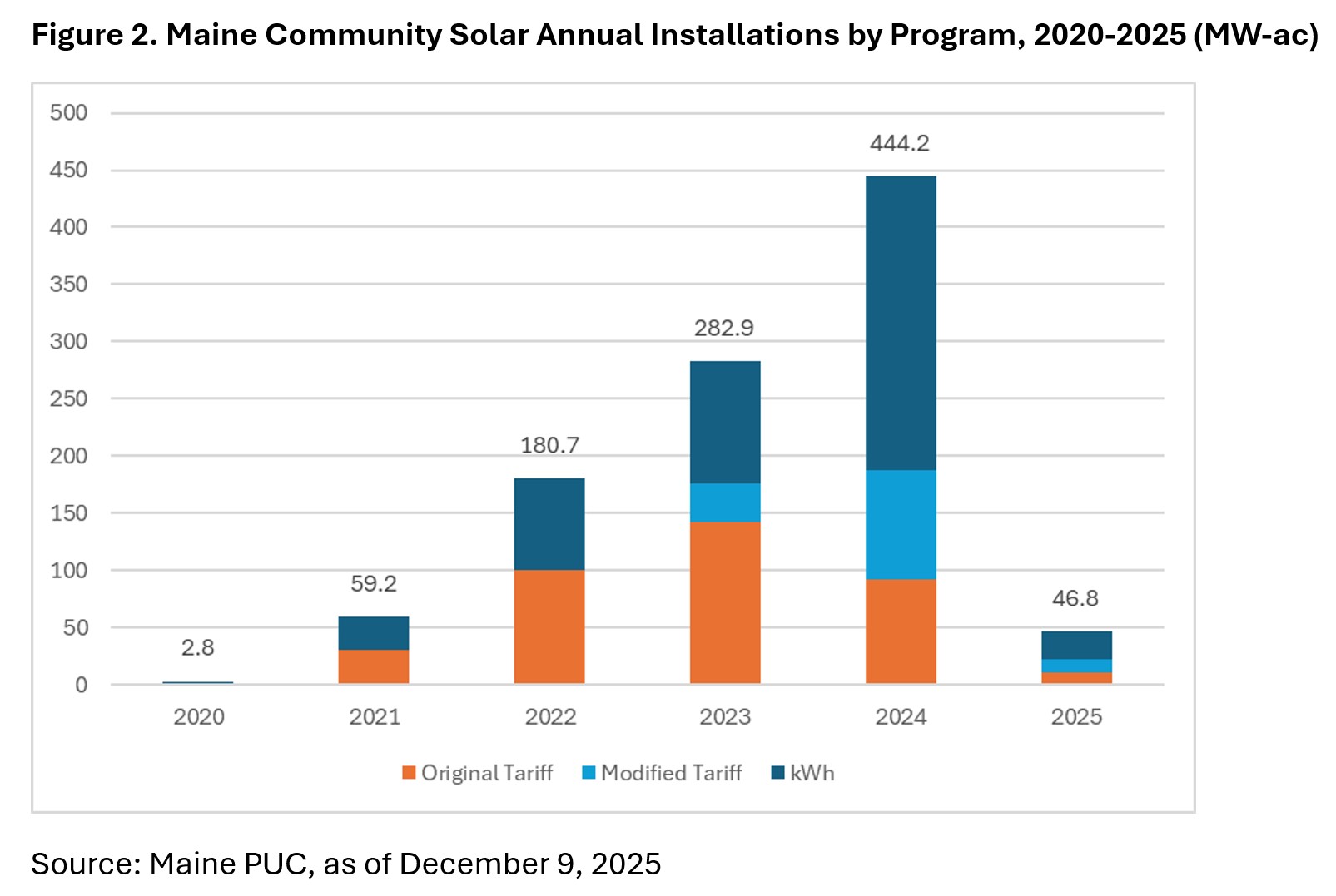
The lawsuit caps a tumultuous year for Maine’s community solar market. Installations fell from a record 444 MW-ac in 2024 to just 47 MW-ac in 2025 – an 89% decline. Many project owners are entering the new year with stranded assets, and 2026 utility supply rates are set to rise sharply.
Although market participants had anticipated legislative changes for months, LD 1777 nevertheless sent shockwaves through the industry – particularly because of its significant retroactive provisions, something without precedent in the community solar sector. Before being approved by the Governor, the Senate vote of 20-14 showed diverging opinions on the bill. In fact, some Republicans felt the bill didn't go far enough, while others sided with industry.
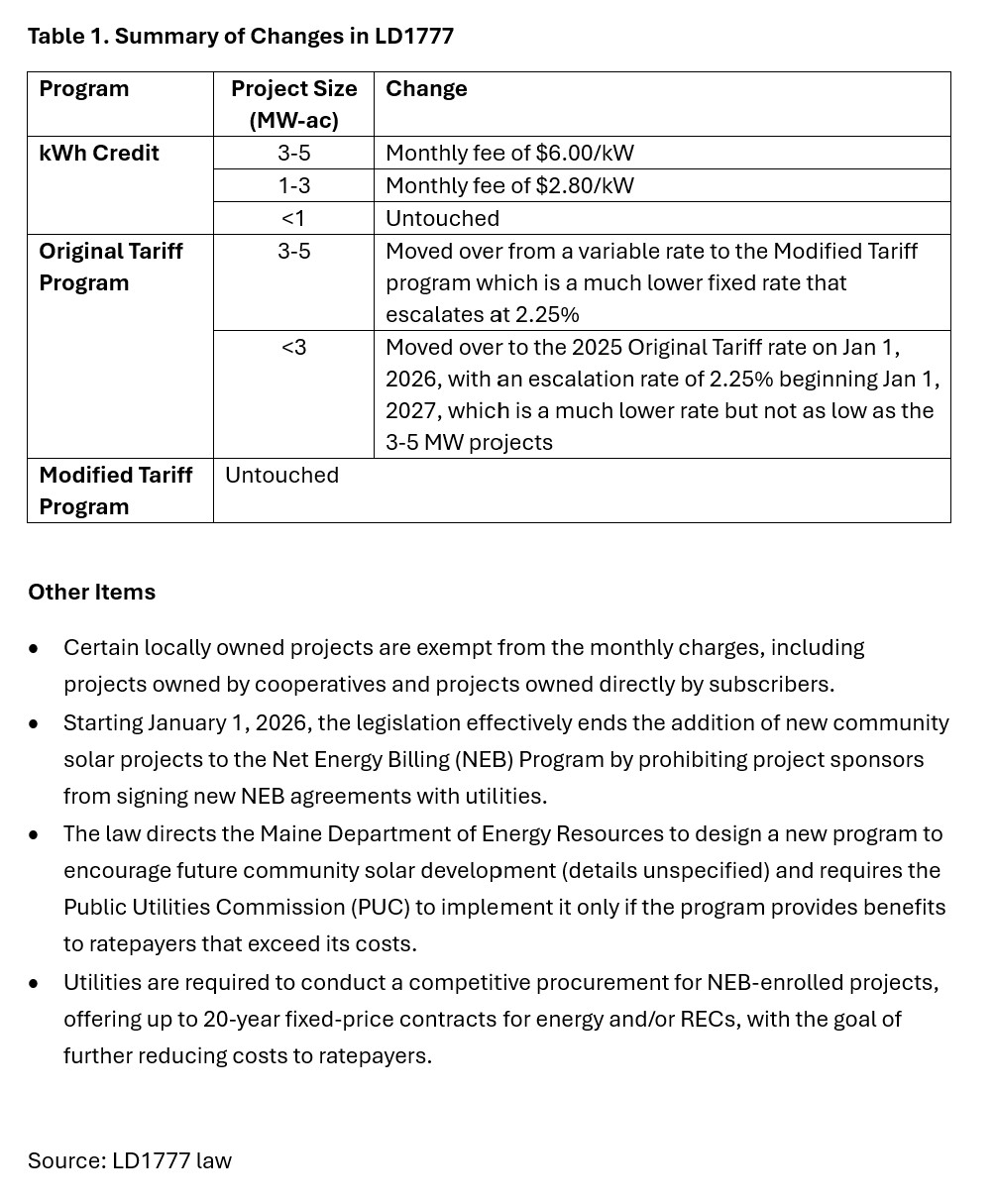
As the bill advanced through the Legislature, I published an update on June 10 – seventeen days before final passage. Table 1 summarizes the enacted law. Owners of the largest projects, in the 3–5 MW-ac range, face the steepest reductions under both the kWh Credit Program and the Original Tariff. Owners of 1–3 MW-ac kWh Credit projects and Original Tariff projects under 3 MW-ac also see meaningful impacts, while kWh Credit projects under 1 MW-ac were left untouched. Almost all of the plaintiffs’ assets fall within the hardest hit 3–5 MW-ac category.
With only days remaining before year-end, it is still uncertain whether the court will grant the requested injunction.
Standard Offer Rates for 2026 and CMP’s 5-year plan
Standard Offer rates for 2026 were approved in November. On average, they will be increasing by 19.0% (weighted average by load) over 2025 in CMP territory, and 19.4% across CMP and Versant.A summary of the new rates is in Table 2.


At the same time that the Maine PUC announced the Standard Offer rates, it rejected Central Maine Power’s (CMP) five-year plan. CMP had proposed a $1.4 billion investment and the addition of 400 new full-time employees, primarily to enhance storm preparedness and strengthen the grid. Given the high rates, more than 800 members of the public submitted written comments on the proposal. The PUC declined to approve the plan and has opened a proceeding to develop guidance for a multi-year rate plan that would include greater stakeholder participation.
Evolution of Rates, 2020-2026, and the Impact of Policy
Electricity rates in Maine matter to both investors and policymakers, though their interests often diverge. Investors in the kWh Credit Program benefit from higher retail rates, while policymakers focus on affordability and therefore seek to keep rates as low as possible while still providing reliable service.
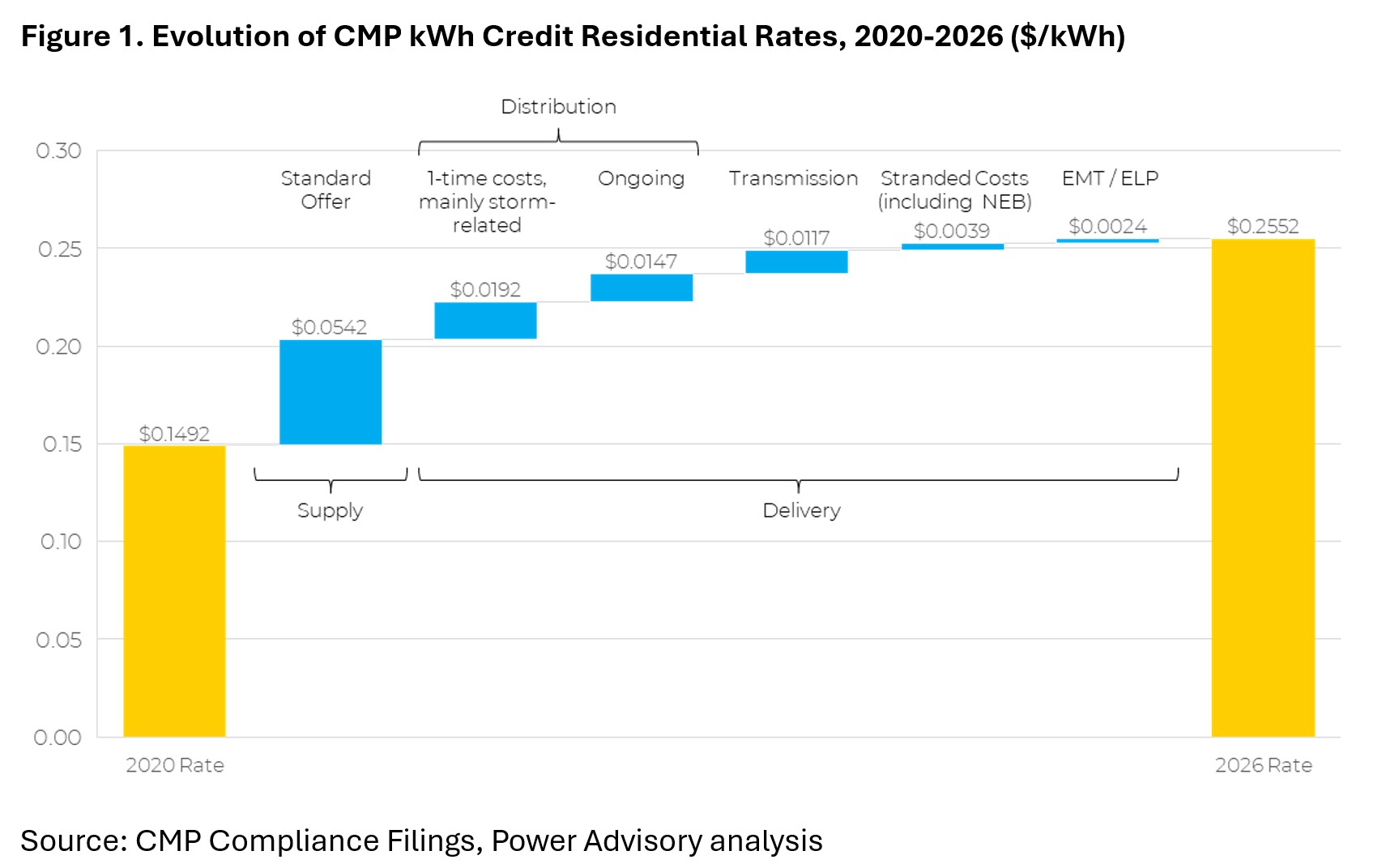
Figure 1 illustrates how residential rates in CMP territory have changed from 2020 to 2026. Over this period, combined supply-and-delivery charges rose from $0.149/kWh to $0.255/kWh – a 71% increase. The largest driver of this increase was the supply charge, known as the Standard Offer, which rose primarily due to elevated natural-gas prices, the marginal fuel in New England’s power market.
Delivery charges also increased, though for different reasons. The most significant jump came from extraordinary storm-related costs, which are one-time in nature and expected to decline in future years. The remaining increases stemmed from ongoing distribution and transmission charges.
Other cost components played comparatively minor roles. Charges that fund energy-efficiency programs and low-income assistance contributed only modestly to the overall increase. Stranded costs, which include the costs of the NEB program, rose only slightly over this period. Although NEB-related costs have been small to date, they are expected to grow as the large volume of recently installed projects comes online.
Notes:
Maine’s recent electricity price increases illustrate that state policymakers have limited influence over the largest components of customer bills. Most cost drivers originate outside state control. Supply rates are set through the ISO-New England wholesale market and depend heavily on regional fuel costs – especially natural gas prices and pipeline constraints. Transmission rates for New England, including Maine, are governed by a FERC-approved tariff. Transmission-owning utilities file their cost-of-service and revenue requirements at FERC, and the resulting charges are recovered through a regional tariff administered by ISO-NE. Major transmission project costs are often allocated across the entire region on a load-ratio-share basis, meaning Maine customers pay a share proportional to Maine’s share of total regional electricity use. Distribution rates, the only major component regulated directly by Maine policymakers and the Maine PUC, have risen primarily due to factors like storm-related repair costs and grid-hardening needs. Even so, distribution, excluding one-time costs, remains a comparatively small portion of residential customers’ total electric bill, about 20%. And policy can really only change that around the margins.
In October, Maine legislators debated proposals including LD 1223, which would grant a refundable income-tax credit equal to 6% of the total electricity costs a household paid in the previous calendar year. The credit is designed to help offset the portions of those bills that fund various assistance and subsidy programs – including net energy billing, the low-income assistance program, and the arrearage-management program for customers who are behind on payments. A separate bill is also being drafted that would provide a flat $50/month tax credit for qualifying low-income ratepayers. Both bills are slated for reconsideration when the legislature reconvenes in January.
While policymakers describe LD1777 as common sense reforms to the NEB program that would save ratepayers money, critics argue that it undermines investor confidence, threatens the local economy and jobs, and clean energy goals, and unfairly shifts costs onto the solar projects which are not the real cost drivers of rates.
Market Size
As shown in Figure 2, community solar annual installations skyrocketed from less than 3 MW-ac to 444 MW-ac in just four years (2020 to 2024). As LD1777 was being discussed and eventually signed into law in 2025, installations ground almost to a halt, and just 47 MW-ac was installed during the year.
Stranded Assets
Many projects remain stranded, including those under development, under construction, or even already electrically connected. Beginning January 1, 2026, these projects are no longer eligible to enroll in NEB, as the program is closed to new participants. LD 1777 directs the Maine Department of Energy Resources to design a new program to encourage community solar development. However, no timeline has been provided, and the PUC will implement the program only if it determines that benefits to ratepayers exceed the costs.
In the meantime, options for these stranded projects are limited. They may sell into the wholesale market or participate in a future competitive procurement designed for projects of their size. Another option would be to negotiate a bilateral PPA with a corporate offtaker, though demand would be very limited.
Options for Projects Currently Enrolled in NEB
One of LD 1777’s requirements is the issuance of a competitive solicitation for energy and/or RECs from projects currently enrolled in Maine’s Net Energy Billing (NEB) program. That RFP was released on October 31. Instead of remaining in NEB, eligible projects may now propose long-term, fixed-price contracts to sell their output directly to Maine’s utilities. The intent is to reduce overall costs for ratepayers. For project owners, a 20-year contract also offers significantly greater revenue certainty compared to the NEB program, which – as recent legislative changes have demonstrated – can be modified.
To qualify, a project must already be operational or must achieve commercial operation by November 1, 2025, and must be actively participating in NEB. Bidders may offer energy, RECs, or both at fixed prices for terms of up to 20 years. Although the solicitation has no MW cap, it does include $/kWh price caps, which represent a substantial discount relative to prevailing NEB compensation levels.
Bid prices must be structured either as a flat fixed rate or as a rate with a fixed annual escalator. The not-to-exceed energy-only price caps for 20-year contracts are presented in Table 3.
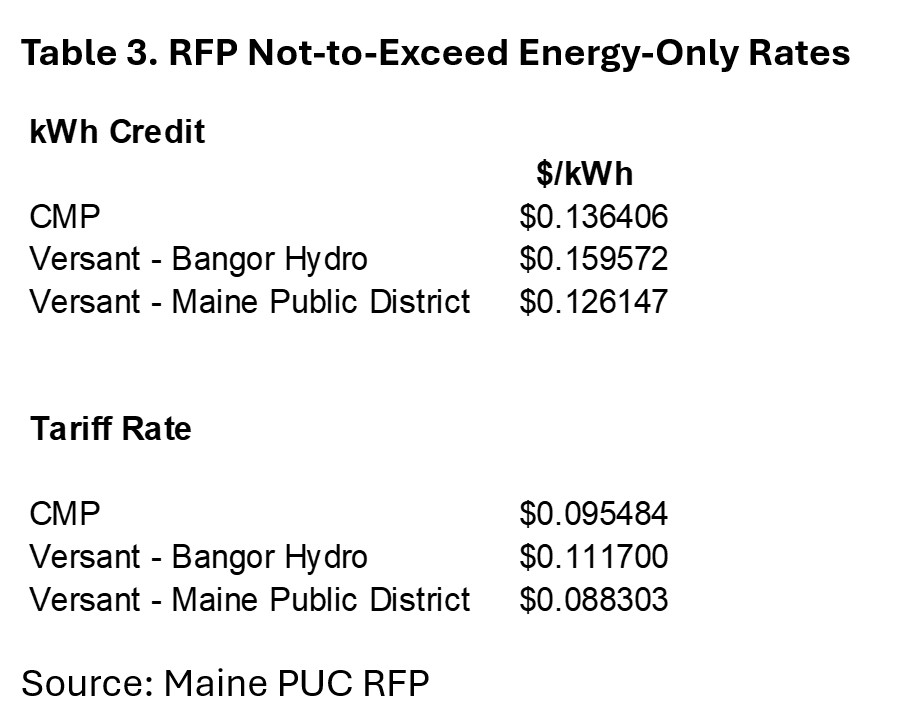
These prices are comparable, though slightly lower, to where pricing cleared in a similar RFP in 2023. In that RFP, for 1-2 MW DG projects, the PUC selected six projects as follows:
Conclusion
The Maine community solar market is in a transitional and highly uncertain phase:
Andrew Kinross can be reached at akinross@poweradvisoryllc.com. Please reach out for further information.