
On October 5, 2026, New Brunswick Power (NB Power) released its 2026 Integrated Resource Plan (IRP).
NB Power is obligated to submit the IRP every three years to the provincial government under the Electricity Act, with the 2026 IRP approved by the provincial government in September 2026. The IRP has also been filed with the New Brunswick Energy and Utilities Board as part of the General Rate Application. While the IRP is a key document in planning for the province’s electricity grid over the next two decades, NB Power noted in its release that the plan itself does not authorize the retirement, construction or procurement of generating resources and any such decision would require a “separate business evaluation, regulatory requirements, approvals and stakeholder engagement”.
2026 IRP Overview
The 2026 IRP considers four base scenarios incorporating a high and low demand scenario. Whereas the 2023 IRP varied the pace of SMR deployment as a key variable in its different scenarios, the 2026 IRP considers the achievement of net zero by 2035 or net zero by 2050 (reflecting existing policy) as the key variable in differentiating between scenarios. The 2026 IRP no longer includes new nuclear in any of the four base scenarios. Instead, the IRP includes new nuclear capacity as an additional sensitivity analysis beyond the base scenarios.
NB Power has already expanded its generating capacity by entering into agreements with Independent Power Producers (IPPs) to develop 702 MW of wind, 500 MW of combustion turbines ( with 100 MW to be exported) and 117 MW of large industrial biomass by 2028/29. These agreements are incorporated in all scenarios and sensitivities across the IRP.
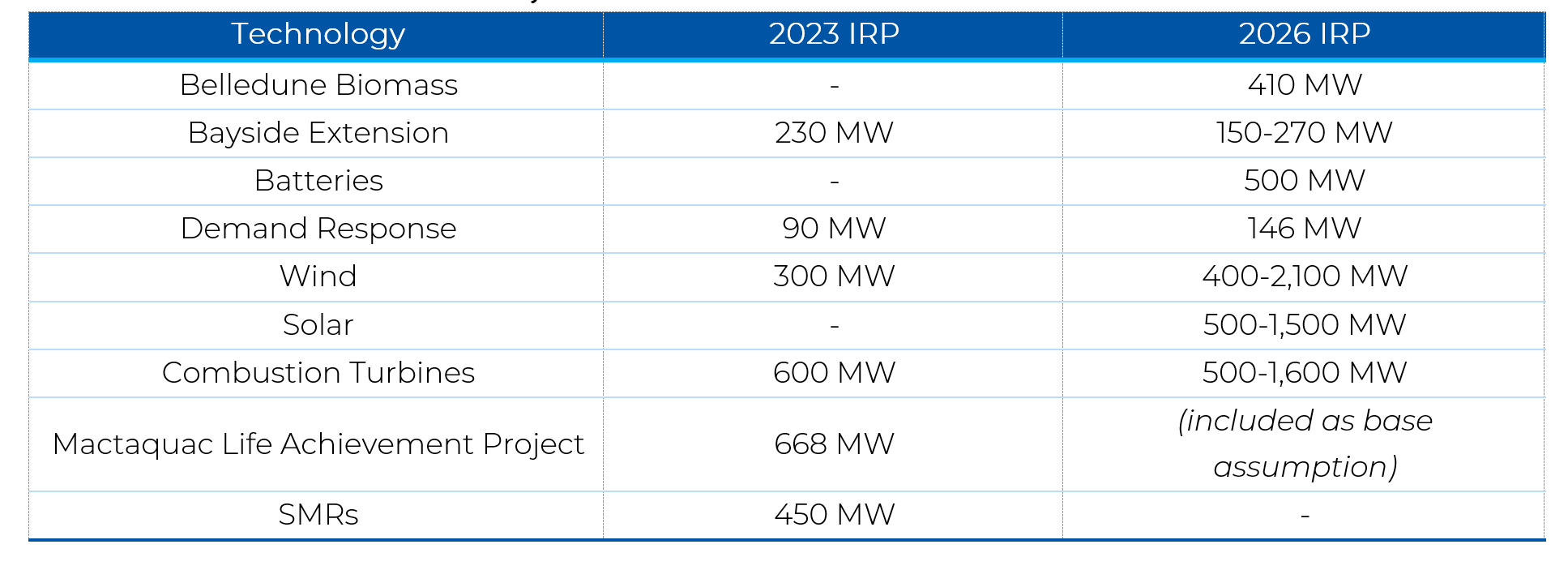
The IRP includes a number of other action items across all of the scenarios. The table below compares the common action items from the 2026 IRP with the 2023 IRP. With SMRs no longer considered in the supply mix in the 2026 IRP, other resources now fill the gap, namely batteries, wind, solar, combustion turbines and demand response. In addition to the 702 MW of new wind, the 500 MW of combustion turbines and 117 MW of biomass, the Mactaquac Life Achievement Project is also included in all scenarios. Although the Belledune conversion was an option in the 2023 IRP, it was not considered a “common action” across all four previous scenarios whereas it is now included in the four base scenarios for the 2026 IRP.
Summary of Common Actions: 2023 IRP vs 2026 IRP
A Door Closes for SMRs, Another Door Opens for New Nuclear
The most notable update to the 2026 IRP – in comparison to the previous 2023 Integrated Resource Plan released on August 3, 2023 – is the absence of Small Modular Reactors (SMRs) that were included across all scenarios in the previous plan, with 450-750 MW planned as early as the mid-2030s. The inclusion of SMRs in the previous IRP was made to align with the previous government’s climate change plan, which called for an energy strategy that would include “the development of two first-of-their-kind small modular reactor technologies”. The previous government’s energy strategy released in December 2023 (Powering our Economy and the World with Clean Energy) set a target of 600 MW of SMRs at Point Lepreau by 2035.
The October 2024 election led to a change in government and in February 2025, NB Power CEO Lori Clark expressed doubts that ARC Clean Energy’s SMR would be ready on time to meet system needs. In October 2025, Energy Minister René Legacy backed away from the technology, stating that the new government wasn’t interested in building a first-of-a-kind SMR at Point Lepreau as they’re “always the most expensive”.
In April 2025, the Government of New Brunswick launched a review of NB Power to address “rising electricity rates, system reliability, and financial challenges, including a high debt-to-equity ratio”. One of the panel’s 50 recommendations from their March 2026 report (#38) recommended that the government initiate an assessment for an “additional large scale, proven technology nuclear plant”, with no mention of developing SMRs. In May 2026, the New Brunswick government responded to the independent review of NB Power with the NB Power Action Plan. The government accepted recommendation 38 to consider the role of nuclear generation in New Brunswick, with an evaluation process and workplan being developed, and a target date of March 2027. In June 2026, the federal government launched its nuclear energy strategy, with one of the key objectives to enable the construction of up to ten new large-scale reactors within Canada, with “at least one nuclear deployment (including SMRs) operational or under construction outside Ontario by 2035”. In response to the federal government’s nuclear energy strategy, New Brunswick’s Energy Minister stated that “the easiest path to get new nuclear in Canada outside of Ontario by 2035 is going through Point Lepreau”.
Power Advisory Commentary
The province’s nuclear planning assessment, with its first miestone due in March 2027, will have an impact on the buildout of other supply options in New Brunswick. With a range of scenarios included in the 2026 IRP, the planners at NB Power have laid out multiple pathways to meet future supply needs which will prove helpful in comparing against any nuclear announcement that considers new nuclear as a supply option.
Importantly, based on public statements from the provincial government in support of new nuclear in New Brunswick, the most likely supply mix for the province stemming from NB Power’s 2026 IRP may be one of the sensitivities: New Nuclear. If New Brunswick moves ahead with new nuclear – which may be signalled in the province’s nuclear workplan due March 2027 – the amount of supply required from other options will be reduced by 0.8-1.6 GW, mostly from wind and solar, depending on the scenario.
A full costing of a new nuclear scenario is not provided in the IRP, but NB Power does provide levelized cost of energy and capacity for large new nuclear at $177/MWh and $122/kW-month, respectively, in 2030 Canadian dollars. However, as the 2026 IRP points out, this decision is not a matter of simply comparing the costs of one resource against another, noting that “there are still technical, economic and policy considerations to understand before making a decision to commit New Brunswick to new nuclear generation”. NB Power also acknowledges that the sensitivities for new nuclear are not meant to “predetermine a set volume of nuclear but to identify what in the expansion plan would change and to understand the changes in total system and capital costs between the sensitivity scenarios and the base scenarios”.
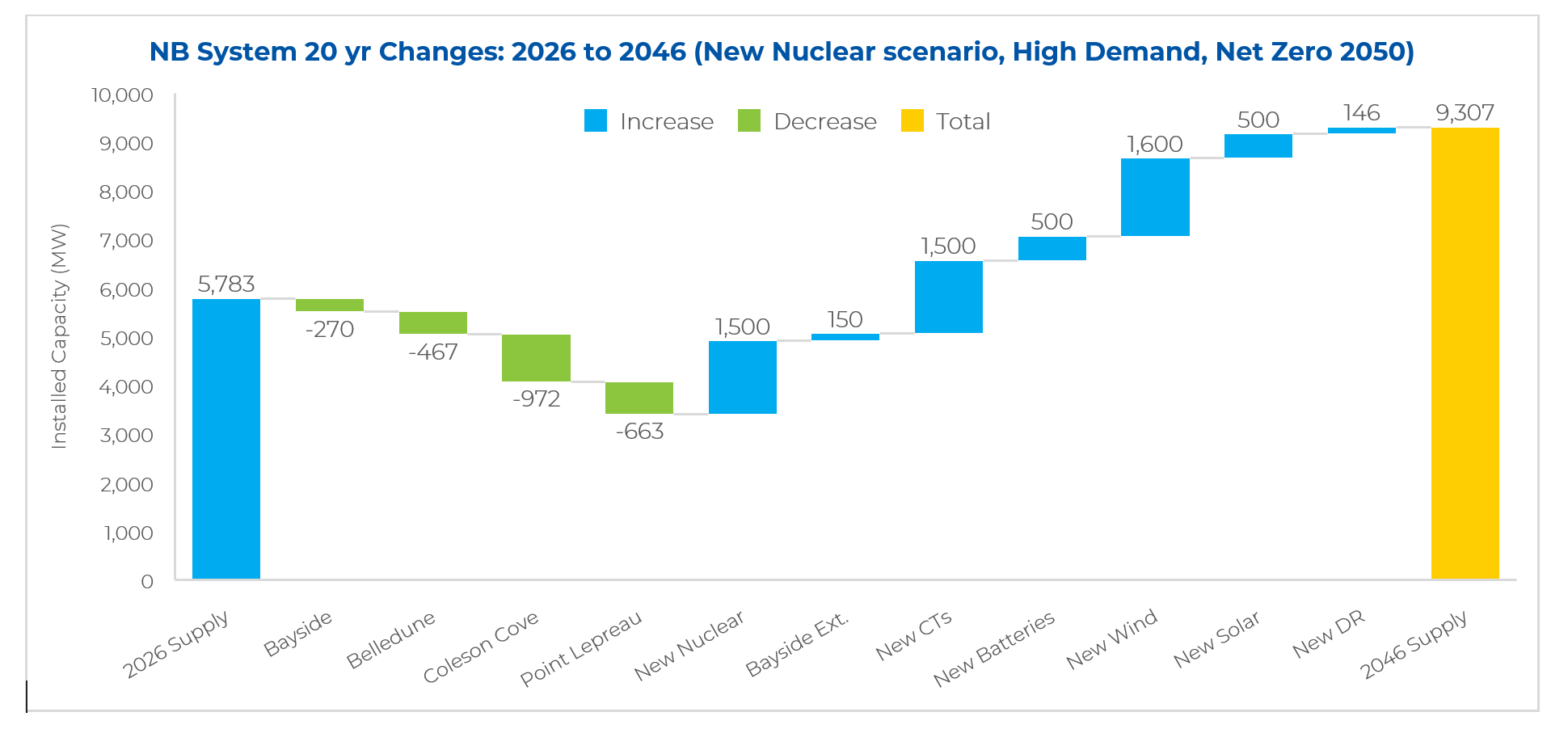
Under the high load forecast scenario and assuming existing policy (i.e., net zero by 2050), adding new nuclear would see a New Brunswick grid with 5.8 GW of existing and committed supply lose 2.4 GW to retirements (1.7 GW thermal plus Point Lepreau’s 663 MW) and add 5.9 GW of new supply, mostly wind, nuclear and new combustion turbines. A summary of changes across the 20-year timeline under the 2026 IRP scenario for new nuclear, net zero 2050, high demand forecast from 2026 to 2046 is shown below (2026 Supply includes committed supply not yet in-service). Total installed and committed capacity grows from 5.8 GW today to about 9.3 GW by 2046.
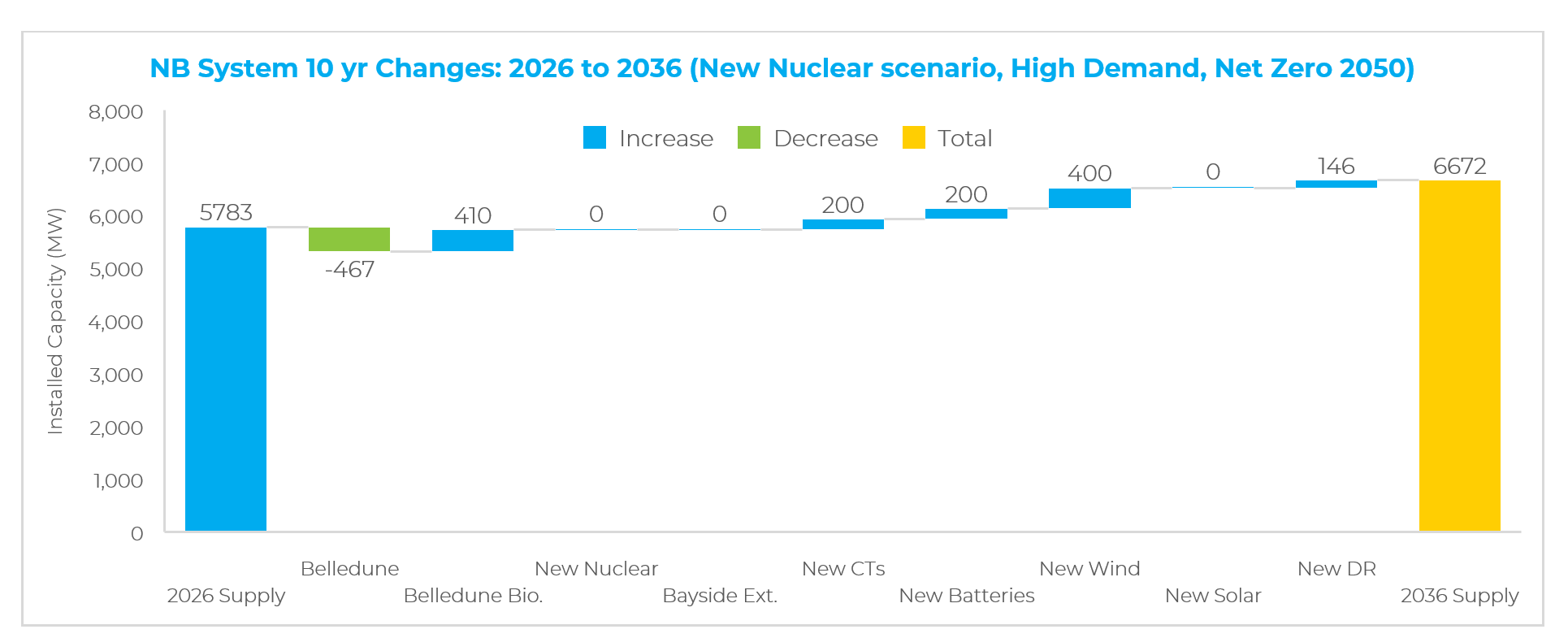
The 10-year timeline for the new nuclear, net zero 2050, high demand forecast in the 2026 IRP shows a slower build-out than its 20-year total. As no new nuclear is added within 10 years, the new supply includes the conversion from coal to biomass at Belledune allowing the plant to operate past the 2030 coal phase-out date by 10 years, and 200 MW of new CTs, 200 MW of new batteries, 400 MW of new wind and 146 MW of new DR. A summary of changes across the 10-year timeline under the 2026 IRP scenario for the new nuclear, net zero 2050, high demand forecast from 2026 to 2036 is shown below (2026 Supply includes committed supply not yet in-service).
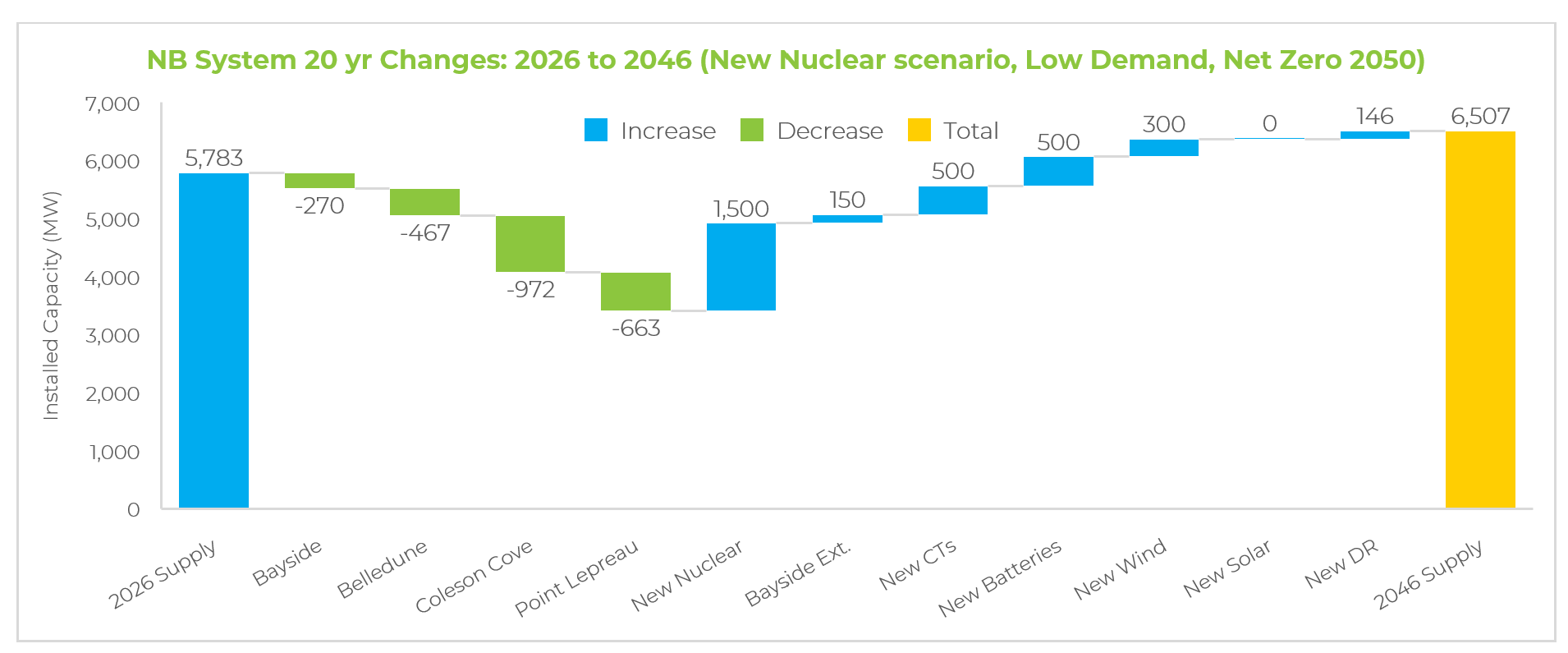
Under the low load forecast scenario and assuming existing policy (i.e., net zero by 2050), adding new nuclear removes the need for new solar altogether, reduces wind additions from 1,600 MW to 300 MW and reduces combustion turbines from 1,500 MW to 500 MW. A summary of changes across the 20-year timeline under the 2026 IRP scenario for the new nuclear, net zero 2050, low demand forecast from 2026 to 2046 is shown below (2026 Supply includes committed supply not yet in-service).
NB Power’s 2026 IRP notes that the addition of nuclear provides “large volumes of reliable energy with very little dependency on other resources in comparison with the base scenario”. In terms of future procurement opportunities for IPPs in New Brunswick, under the high demand scenario, NB Power’s new nuclear sensitivity still builds about 4 GW of new renewables, thermal generation and demand response over the next 20 years. Nonetheless, the capacity expansion over the next decade – even with high demand – is expected to be more modest, assuming the province moves ahead with its nuclear expansion. As such, if electricity demand does not materialize in New Brunswick (i.e., the low demand forecast scenario) and the province moves forward with its nuclear expansion plans, opportunities for IPPs would be smaller and come later.
From a broader perspective, additional nuclear in New Brunswick may support regional electricity partnerships, as stated in the 2026 IRP. This view is supported by the recently signed Memorandum of Understanding (MOU) to advance Maritime Regional Electricity Co-operation and System Integration signed by the Premiers of New Brunswick, Nova Scotia and Prince Edward Island. However, consideratable uncertainty remains regarding how the future system will be dispatched in New Brunswick and more broadly, across the Maritimes. Additional nuclear situated in New Brunswick may provide broader value due to the grid’s interconnections with other markets, such as New England and Québec, as well as its Maritime neighbours.
Although NB Power is forecasting a broad range of electricity demand, neighbouring jurisdictions such as Québec and New England are predicting significant demand growth. With nuclear decisions typically made 15 to 20 years in advance (as noted in the 2026 IRP) and an expected extended lifetime of 60 years, the upcoming decision on whether or not to build new nuclear, and how much, is expected to have a regional impact for decades to come.