
On October 27, 2026, Ontario’s Minister of Energy and Mines announced “a series of legislative and regulatory reforms designed to advance the distribution sector.” These reforms were brought forward as part of the omnibus red tape reduction legislation, Bill 140, Building Ontario Faster Act, 2026 (see Schedule 16). Concurrently, the government released the Report of the Panel for Utility Leadership and Service Excellence (PULSE), which informed some of the reforms introduced. These three items signal a new regulatory, governance, and policy paradigm for Ontario’s electricity distribution sector, particularly for municipally owned local distribution companies (LDCs).
The Panel for Utility Leadership and Service Excellence Report
In October 2025, the Government of Ontario launched PULSE, appointing Anthony Haines (as Chair), and Paula Conboy, Alexander Nuttall and David MacNaughton as panel members. The Panel was asked to provide the government with “recommendations on investment frameworks, operational best practices, and regulatory reform planning needed to deliver a reliable, resilient and future-ready electricity distribution system across Ontario,” and deliver a final report in early 2026.
In setting the context for its recommendations, the Panel noted that current regulatory, governance and funding frameworks are “increasingly misaligned with the scale, pace and complexity of growth in electricity demand now underway across the province […] While much policy attention has focused on generation and transmission, the pace at which growth can be realized increasingly turns on distribution system readiness.”
The Panel paid particular attention to the ability of municipally owned LDCs to fund system growth, finding “[w]hile municipal equity contributions may continue where feasible, the scale and persistence of investment needs mean that a broader range of pathways will often be required […] access to external investment, particularly from Canadian institutional investors, is likely to be a critical determinant of whether electricity distribution utilities can deliver required infrastructure on time and at reasonable cost.”
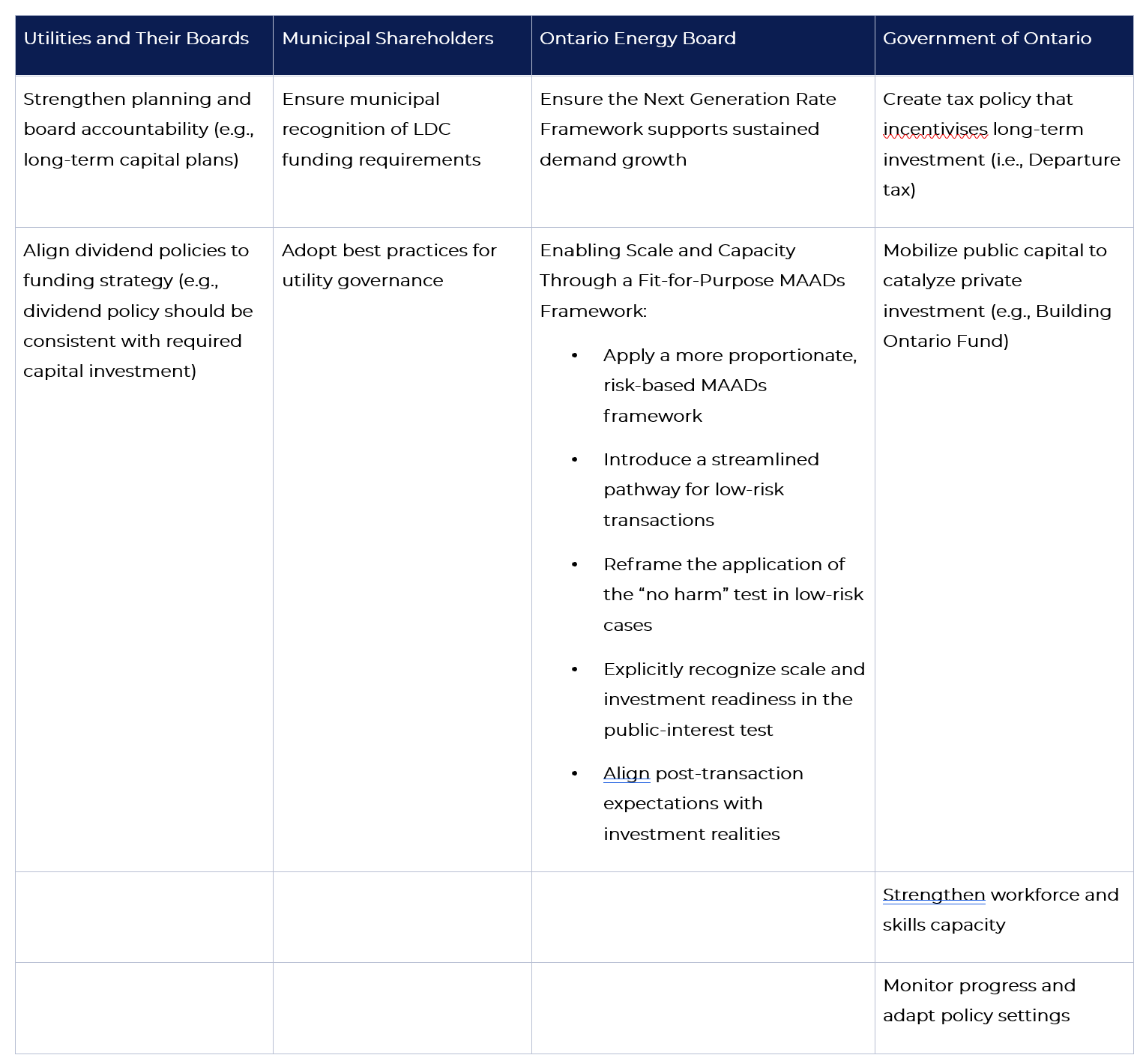
The Panel’s report contains ten recommendations directed across four groups: utilities, municipal shareholders, the Ontario Energy Board, and the Government of Ontario. The recommendations touch upon a wide range of issues, including, but not limited to, LDC planning, governance, accountability and dividend policy; aligning municipal capital budgets with LDC funding strategies, and municipal representation on LDC boards of directors; the OEB’s approach to ratemaking and Mergers, Amalgamations, Acquisitions and Divestitures (MAADs) Framework; and, provincial government policy related to taxation, capital mobilization and workforce development. A summary of the recommendations is presented in Table 1.
Table 1. PULSE Report Recommendations
The Government’s Reform Package
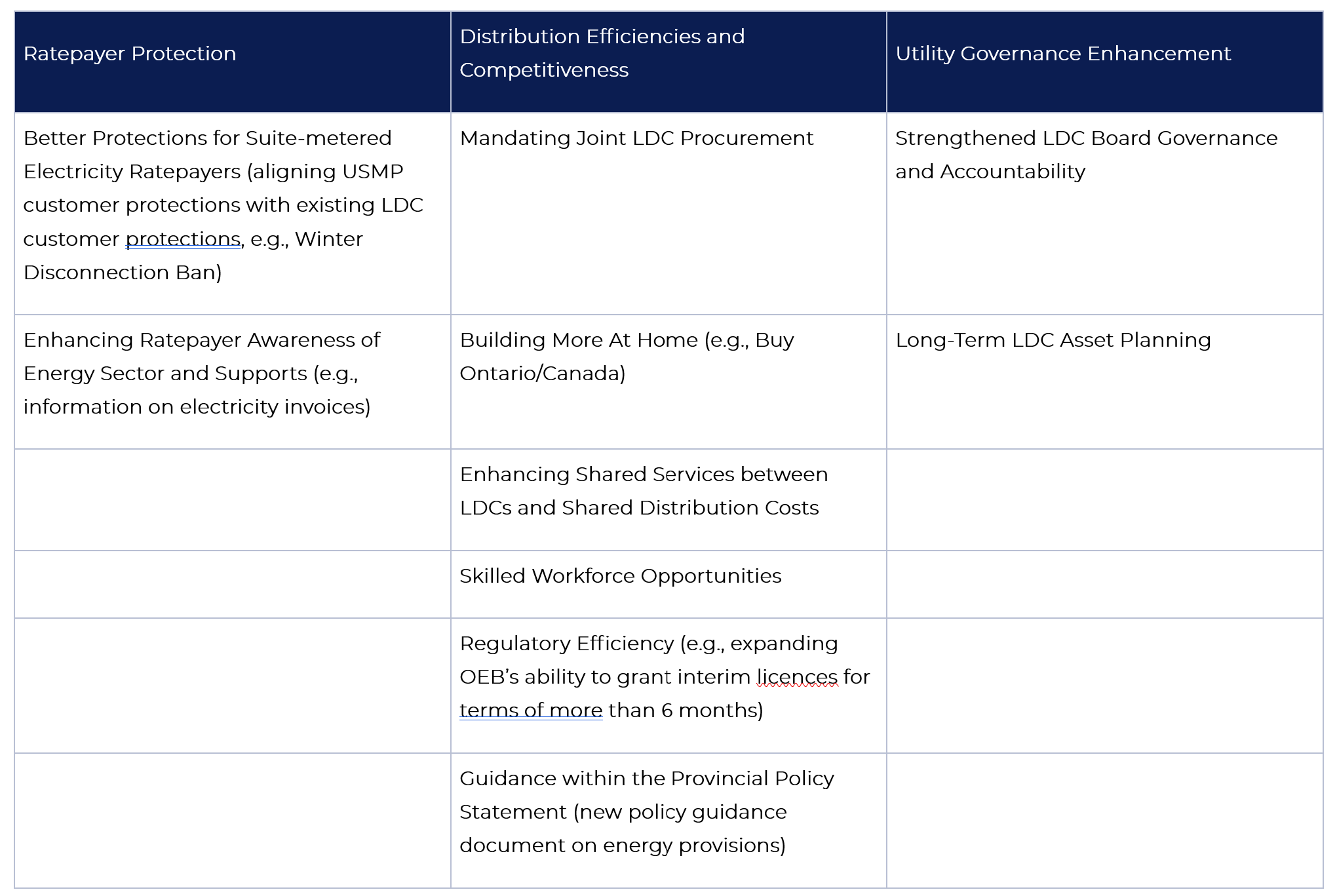
When reviewing the reforms announced by the government, it is important to note that the government describes its measures as “informed by recommendations” in the PULSE report. The proposed legislative changes (and other announced initiatives) fall under three categories: Ratepayerprotection, Distribution efficiencies andcompetitiveness, and Utility governance enhancement.
The most significant amendments to the Ontario Energy Board Act relate to new authorities regarding LDC governance, board composition, dividend policy, and long-term capital planning. However, in many cases, the government’s proposals differ (sometimes significantly) from the PULSE report.
Further, in other cases, the legislation and government announcement are silent on key investor-related PULSE report recommendations dealing with the MAADs framework, tax policy, and mobilizing public capital.
Moreover, the government’s package includes items not mentioned in the PULSE report, such as aligning customer protection requirements of unit sub-meter providers (USMPs) with those of LDCs, greater power to the government over information on or included with electricity invoices, and the development of guidance for municipal energy decision-makers.
A high-level summary of the proposed actions is presented in Table 2.
Table 2. Government’s Proposed Actions
PULSE Recommendations v. Government Package
As noted above, the government reform package was “informed” by the PULSE report. At the same time, it is worth recognizing that the PULSE report cautioned that its “recommendations are interdependent and intended to operate as a coherent package. Implementing them in isolation or with material modification would likely reduce their effectiveness.”
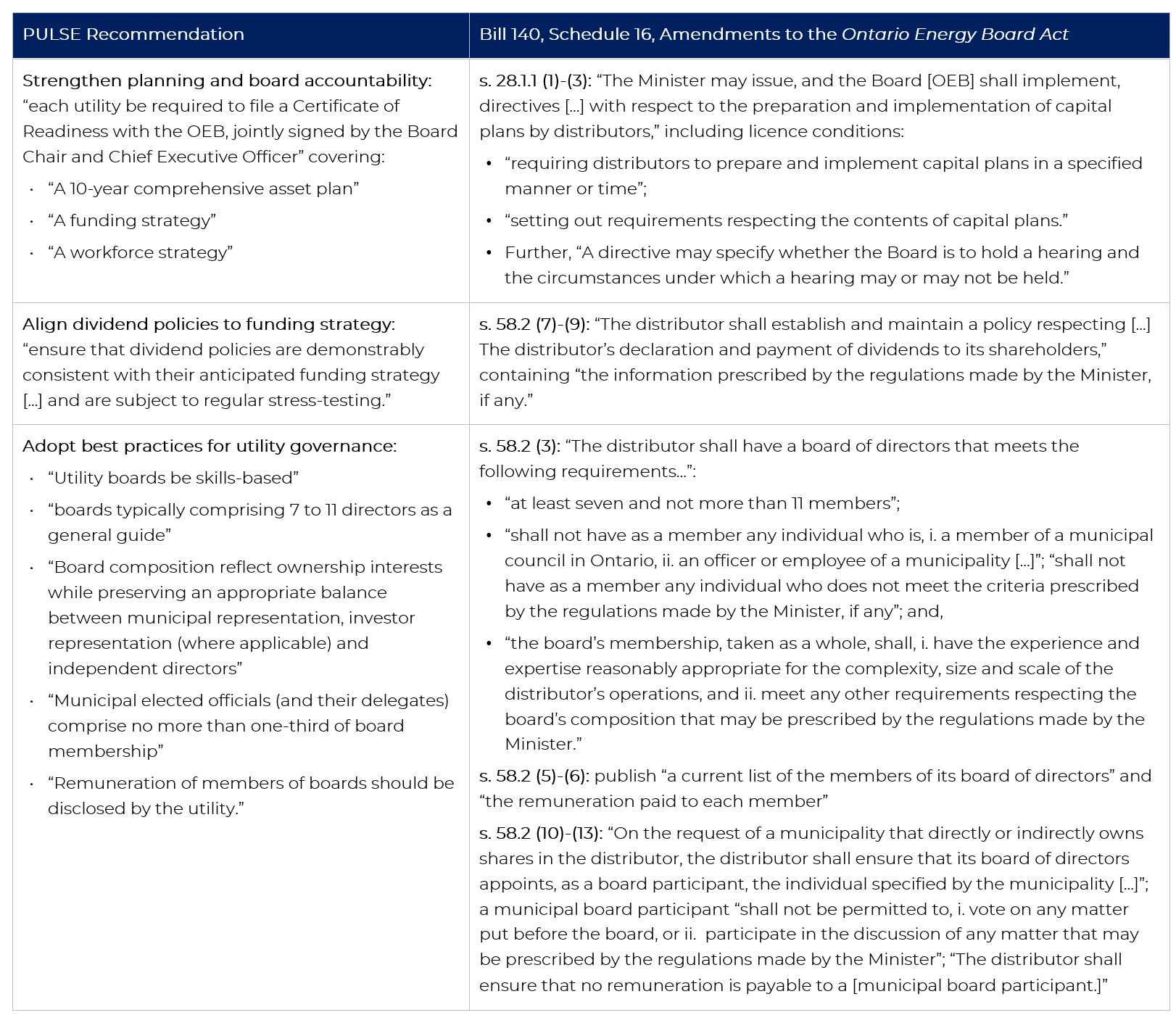
There are material modifications in the government’s reform package. The proposed changes to the governance structures of municipally owned LDCs (i.e., board composition) are more prescriptive and restrictive than the PULSE recommendations, and would give significant directive and/or regulatory discretion to the government (see Table 3 below for examples).
Table 3. PULSE Recommendations Compared to Bill 140, Schedule 16
Commentary
For the past two decades, the role and authority of the provincial government and the Minister responsible for energy over Ontario’s electricity sector have increased steadily. For most of that time, provincial governments have primarily exercised influence over developing the bulk system through high-level planning documents such as the 2025 Integrated Energy Plan; the use of directives and Orders-in-Council to the Independent Electricity System Operator on procurements (primarily generation, and, more recently, transmission), designating certain transmission lines as priority projects; or other avenues such as funding the development of small modular reactors.
Involvement at the distribution level has been relatively limited, such as smart metering, conservation/demand-side management programs, and various time-limited distributed energy resource procurement programs (e.g., feed-in-tariff/standard-offer programs). Up to this point, LDC asset management and capital plans have been governed by OEB rules (e.g., Distribution System Plan filing requirements), prepared by LDCs that inform their rate application filings requiring OEB review and approval in a hearing. However, the proposed rules giving the Minister the ability to direct the OEB on capital planning requirements represent a significant change from the status quo.
Overall, if passed, Bill 140 would represent a step-change in the government’s involvement in Ontario’s electricity distribution sector, extending to the distribution sector the direct government influence that exists over transmission and generation. Indeed, the government makes this point clear in its Bill 140-related electricity announcements, stating “[d]istribution is the remaining pillar to fully realize a modern and integrated electricity system.”
There are likely to be additional announcements related to Bill 140 and the PULSE report. For example, the Minister’s December 2025 Letter of Direction to the OEB stated “[f]ollowing receipt of the Panel’s advice and related policy recommendations, an addendum to this Letter of Direction will be provided that outlines next steps for the OEB,” which could include direction on the Next Generation Rate Framework and/or MAADs Framework. Further, the OEB’s 2026-2029 Business Plan noted “[a]s and when any recommendations from the Panel are tasked to the OEB by the Minister, the OEB will work with the Ministry to align on the appropriate prioritization and sequencing.” Indeed, in announcing the reform package, the government stated it “intends to issue a directive to the Ontario Energy Board outlining its expectations for a modern electricity distribution system that can meet the needs of a growing and increasingly electrified economy.”
Further, new regulations (e.g., electricity invoices, dividend policy) and directives (e.g., related to protections for USMP customers) would also be expected following the passage of Bill 140.Additionally, the government may yet take action on the PULSE recommendations on tax policy and mobilizing public capital in the interests of attracting private capital.
In any event, the government appears to have concluded that Ontario’s energy and economic growth ambitions cannot be achieved under the status quo governance, regulatory and funding framework, stating that “[d]espite repeated calls for reform, the distribution sector has seen limited change even as the global economy has evolved and countries increasingly recognize the direct connection between electricity consumption per capita and gross domestic product (GDP) growth, as well as standards of living.”
The result is a package of proposals that would have deep implications for how municipally owned LDCs are governed, planned, and regulated, as well as for the nature of the relationship between municipal owners and their LDCs.
Bill 140 passed First Reading on October 27, 2026. Second Reading is underway, likely followed by Committee review, at which point stakeholders would have an opportunity to provide feedback.
Addendum: On October 29, 2026, the government published two postings on the Ontario Regulatory Registry related to Bill 140: Enabling Joint and Local Procurement for Electricity Distributors and Local Distribution Reforms to Enable Economic Growth. The comment deadline for both postings is November 30, 2026.
Please contactPower Advisoryif you have any questions or would like any additional information.