
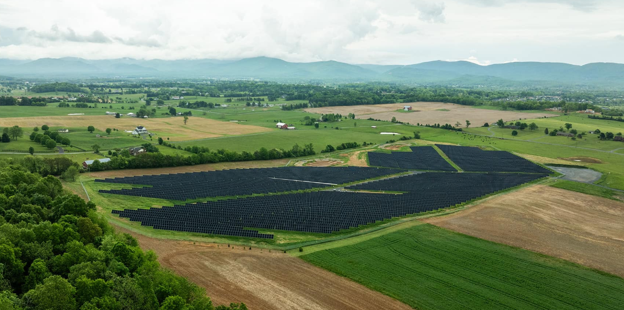
Dimension Energy’s 5 MW-ac Waynesboro Bridge Solar facility in Waynesboro, VA which was one of the first projects enrolled in the Shared Solar Program to go live in 2024. It has about 1,150 subscribers, 30% of which are LMI. Atlanta-based Dimension Energy is the largest owner of projects in the program.
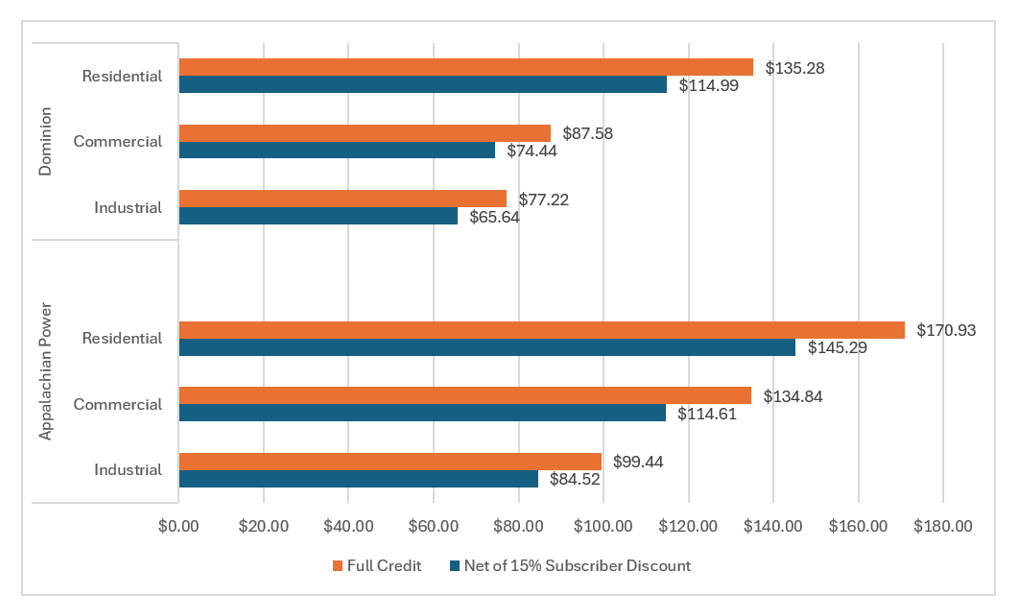
Effective October 1, 2026, the Dominion Residential bill credit rate increases by 2.2% to $135.28/MWh
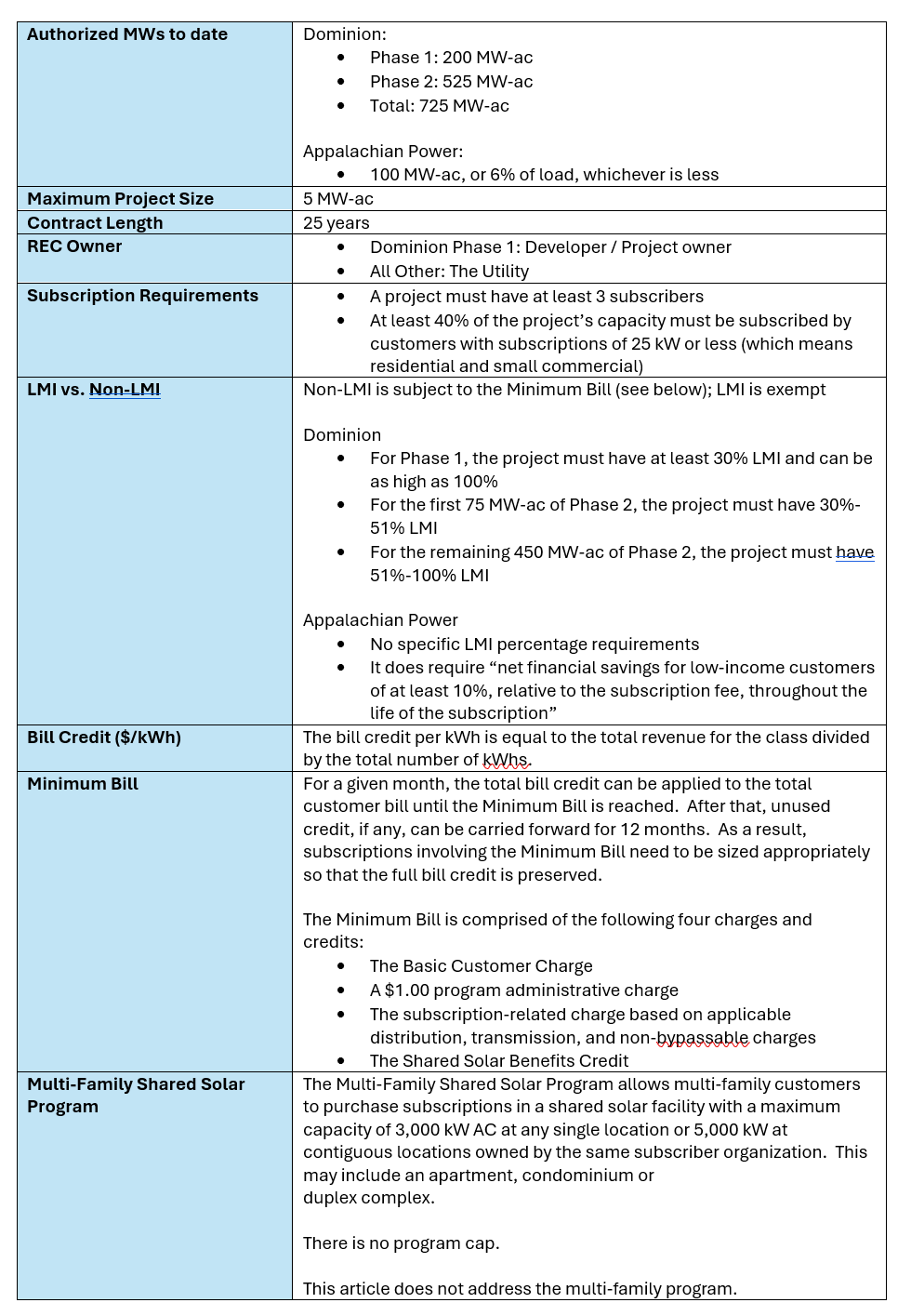
The Virginia Shared Solar Program was first established in 2020 when the Virginia General Assembly enacted Virginia code 56-594.3 and 56-585.1:12. To date, the program has authorized 825 MW-ac and awarded projects totaling 389 MW-ac, 78% of which are in Dominion territory, and the remaining 22% in Appalachian Power territory. Thus, an additional 436 MW-ac of projects can be awarded under the current authorization level.
Some facts about the program are below.
Fast Facts – Shared Solar Program
This article discusses:
Project Awards to Date
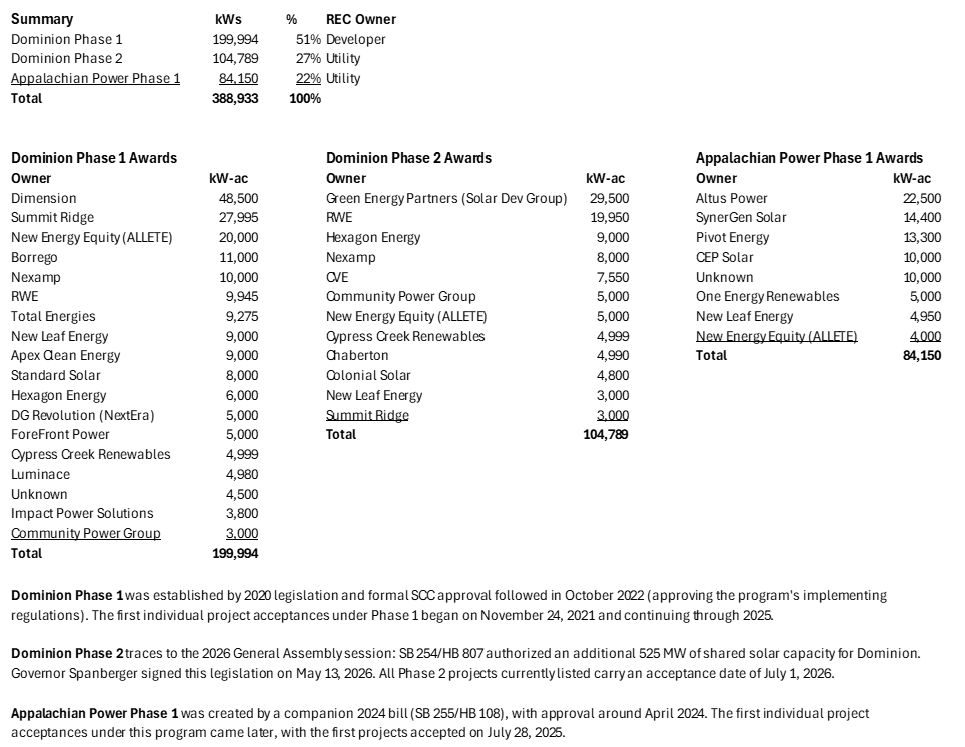
As shown in Figure 1, to date, Dominion has made two sets of project awards and Appalachian Power has made one. Dominion has awarded 200 MW-ac for Phase 1 and 105 MW-ac thus far for Phase 2. Appalachian Power has awarded 84 MW for its program. Appalachian Power’s Program's aggregate maximum capacity is limited to 100 MW or 6% of peak load, whichever is less. In total, some 389 MWs have been awarded. The leading players overall as ranked by megawatts of projects owned are Dimension Energy, Summit Ridge, RWE, Green Energy Partners, and New Energy Equity (ALLETE). There is also a Multi-Family Shared Solar Program (MFSSP) which is separate.
Figure 1. Virginia Shared Solar Program (SPP) – Projects Awarded to Date by Owner
Annual Installations
Figure 2 shows the annual installations of projects from 2024, the first year that shared solar projects reached COD, through 2028. By the end of 2025, some 156 MW-ac had come online.
Figure 2. Annual Installations of Shared Solar Projects, 2024A-2028E (MW-ac)
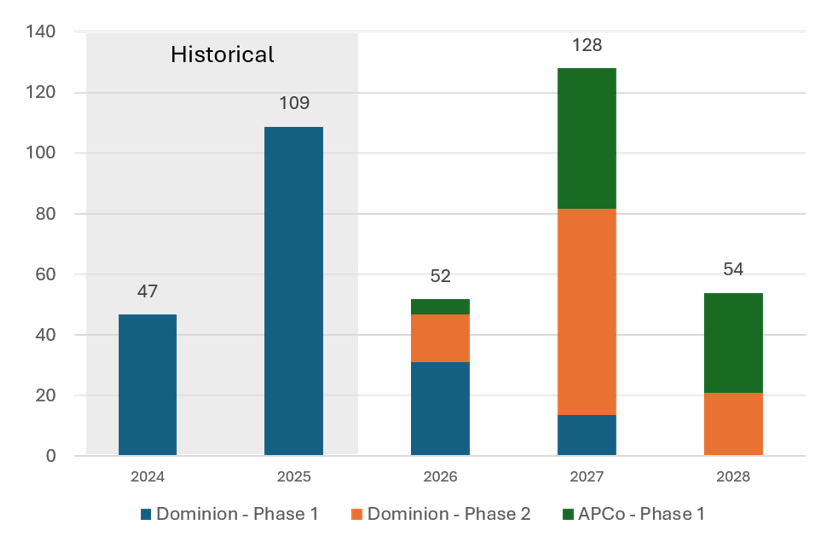
Source: Rough estimates based on project owner forecasts and published utility confirmations of projects online
How Bill Credits are Determined, and Current Credit Rates
There are three rate classes for Dominion and three for Appalachian Power: residential, commercial and industrial as shown in Figure 3. The figure shows both the full credit, and the credit net of an assumed 15% discount that is shared with the community solar subscriber. On a net basis, the Dominion residential credit is $115/MWh, while Appalachian Power is $145/MWh. The bill credit for a given month is equal to the bill credit rate multiplied by the number of subscribed kWhs.
Figure 3. October 2026 Bill Credit Rates ($/MWh)
Sources:
These bill credit rates are lower than those of other PJM community solar programs such as Maryland, New Jersey and Washington DC, but are in the range of expected realized rates for Pennsylvania solar net metering owners. Based on the figure above, the focus for subscription managers is expected to be on residential subscribers for Dominion and residential and commercial categories for Appalachian Power. It’s important to note that, over the long term, Power Advisory forecasts the Dominion rates to escalate noticeably faster than Appalachian Power.
LMI and Non-LMI Residential Subscribers
LMI subscribers are exempt from the Minimum Bill, while Non-LMI subscribers are not. As a result, developers have leaned toward 100% LMI portfolios because there is no risk of unused credit expiring. However, not all awarded projects can choose 100% LMI portfolios. For Non-LMI subscribers, there is a risk of unused credit expiring, though it’s entirely possible to manage it so that doesn’t happen.
How the Minimum Bill Impacts Non-LMI and Commercial and Industrial Subscribers
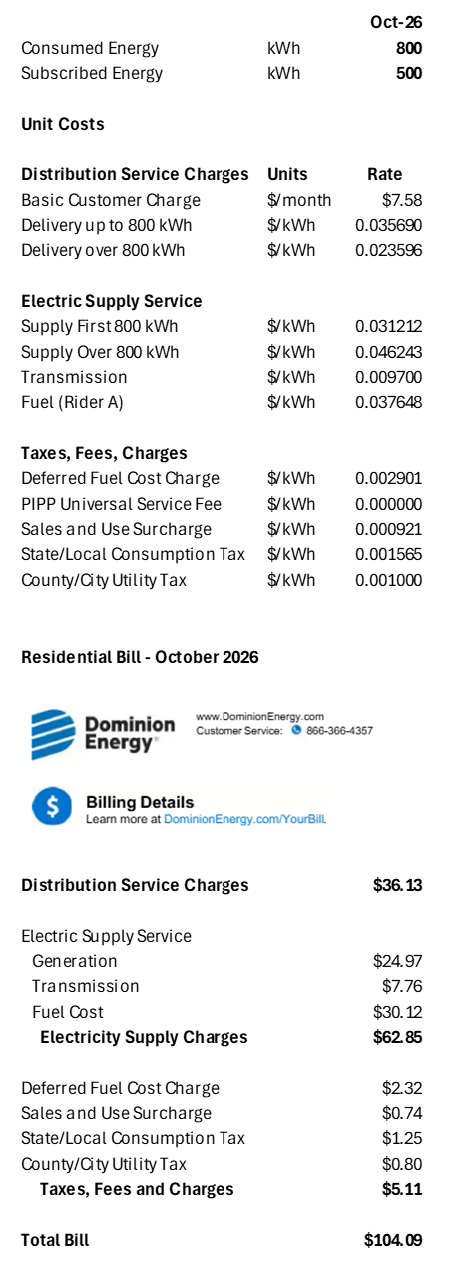
The customer’s total bill is first calculated under the applicable Principal Tariff, which for Dominion is Schedule 1 (see Figure 4 for a calculation of this bill using rates for October 2026). As shown in the figure, consumed kWhs for the month are assumed to be 800 and subscribed solar kWhs are assumed to be 500.
Figure 4. Determination of Total Monthly Bill Charge under Dominion Schedule 1: Residential Service
Calculation of the Minimum Bill
For a non-LMI subscriber, the shared-solar credit can reduce that bill only until the applicable Minimum Bill Charge is reached. The Minimum Bill includes four components:
Using October 2026 rates, and the assumed usage and subscribed kWhs, the Minimum Bill is calculated in Figure 5.
Figure 5. Minimum Bill Calculation, Dominion Residential, October 2026
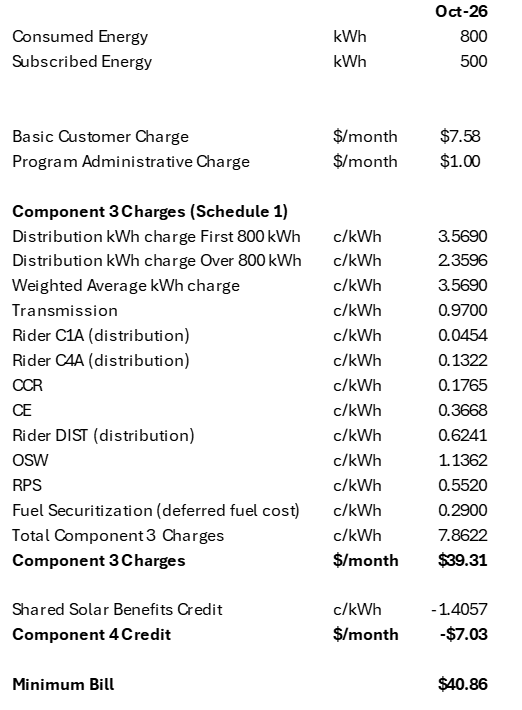
Figure 6 provides a summary of the LMI and Non-LMI subscriber cases for October 2026.
Figure 6. Summary of LMI Subscriber vs. Non-LMI
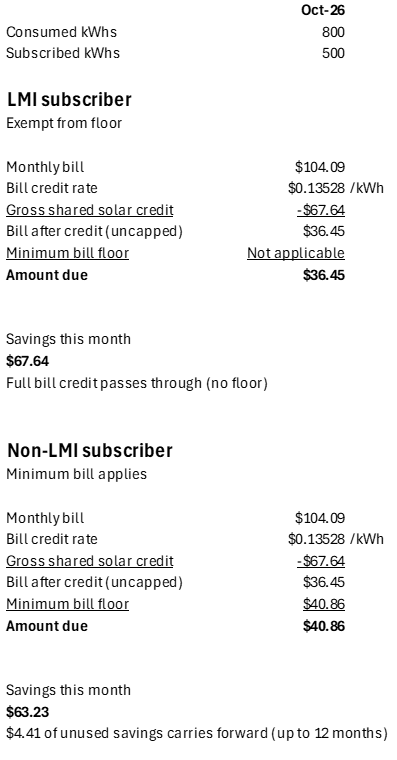
If the monthly shared-solar credit exceeds the amount that can be used against the customer’s current bill – because of the Minimum Bill, low monthly usage, or other billing limitations – the unused amount may be carried forward for use against future bills, subject to the tariff’s 12-month limit. In the example above, there is an unused amount of $4.41. In subsequent months, the customer can use available carryforward credits such as this to the extent that the current bill exceeds the applicable Minimum Bill and there is remaining credit capacity after applying the current month’s credit. Older credits are used first, because unused amounts that remain outstanding after the permitted 12-month period may expire. LMI customers do not have the Minimum Bill limitation, but their credits can still be limited by the amount of their bill and the applicable credit-carryforward rules.
Variation of Consumption Profile and Solar Profile, and Credit Carryforwards
A key driver of the seasonal variation in the total bill and Minimum Bill is the consumption profile (i.e., electricity usage by the subscriber) and the solar production profile. These two profiles are materially different. However, if unused credits generated in one month can be carried forward and fully utilized in subsequent months within the applicable 12-month period, the full value of the credits can be preserved. Under the current rules, any portion of a bill credit that exceeds the subscriber’s monthly bill, less the applicable Minimum Bill, can be carried forward and applied to subsequent bills until the credit is fully used or 12 months have elapsed.
Based on the modeled seasonal profiles, unused credits are most likely to occur during periods when solar production is relatively high compared with subscriber consumption, particularly in the spring and fall, and can subsequently be utilized during months when the subscriber has greater credit capacity. There is a risk that a subscriber’s consumption decreases over time, which could result in some credits expiring before they can be used. A mitigant is the ability to transfer the subscription to another subscriber and appropriately resize the subscription based on the new subscriber’s consumption. Virginia’s subscription-sizing requirement provides that estimated bill credits may not exceed the subscriber’s average annual bill for the applicable customer account. For non-LMI customers, however, annual sizing alone does not necessarily ensure that all credits will be realized, because the Minimum Bill limits the amount of credit that can be applied in a given month. Accordingly, non-LMI subscription sizing should also consider the customer’s monthly consumption profile, Minimum Bill, solar production profile, and the ability to carry unused credits forward for up to 12 months. A further potential risk is that the total bill and Minimum Bill could converge over time, reducing the customer’s monthly capacity to utilize bill credits.
Overall, based on our modeling, Power Advisory sees relatively little downside risk of losing credit value, assuming subscriptions are appropriately sized and subscriber management is effective. The principal distinction is that non-LMI customers require more active subscription management than LMI customers because the Minimum Bill can constrain the amount of credit that can be utilized in a given month. This may result in greater subscriber-management costs and potentially a larger number of non-LMI subscribers required to fully allocate a project’s generation.
Andrew Kinross can be reached at akinross@poweradvisoryllc.com.