
As the Market Consolidates, EQT, MN8, Brookfield Renewable and TPG/Altus Power Emerge as Leading Owners of Operating Distributed Generation (DG) Assets
For much of the past year, a large number of distributed generation (DG) platforms and portfolios were on the market, but relatively few transactions closed. That changed in July and August, when a wave of deals was completed, including several significant transactions. This recent M&A activity has materially reshaped the competitive landscape, with several companies strengthening their positions as leading owners of operating DG assets. At the same time, a substantial number of platforms and portfolios remain for sale, suggesting that further consolidation is likely.
The DG sector has historically been highly fragmented, comprising dozens of early-stage and late-stage developers, and short- and long-term asset owners / independent power producers. As the market matures, however, consolidation is creating larger companies with greater scale and broader capabilities. These companies can benefit from economies of scale, stronger balance sheets, more reliable supply chains, greater geographic reach, and the ability to bring development, construction, financing and operations under one roof. That consolidation is now well underway.
Several other forces are accelerating this shift. Following passage of the OBBBA last year and the resulting phaseout of the ITC, many companies have scaled back solar project development outside the relatively small number of markets that remain attractive (by contrast, storage project development remains a viable market over a longer time horizon since the ITC doesn’t go away for many years). Instead, they have increasingly focused on completing safe harbored projects already in their pipelines and operating existing assets.
The changing policy and market environment has also prompted some companies to reconsider their participation in the sector altogether. Some foreign-based companies with U.S. operations, for example, have elected to exit amid heightened market uncertainty. Other companies active in both DG and utility-scale renewables have shifted resources toward utility-scale development, where larger individual projects can provide a faster path to growth. Regulated utilities have also continued to divest certain unregulated businesses to sharpen their focus on core regulated operations, as illustrated by AEP's 2024 sale of OnSite Partners to Basalt Infrastructure.
Recent acquisitions
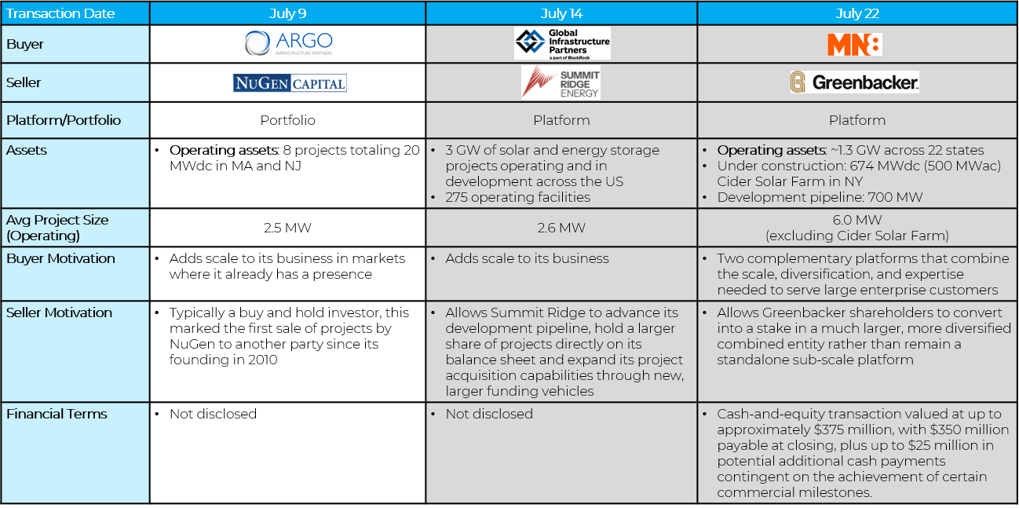
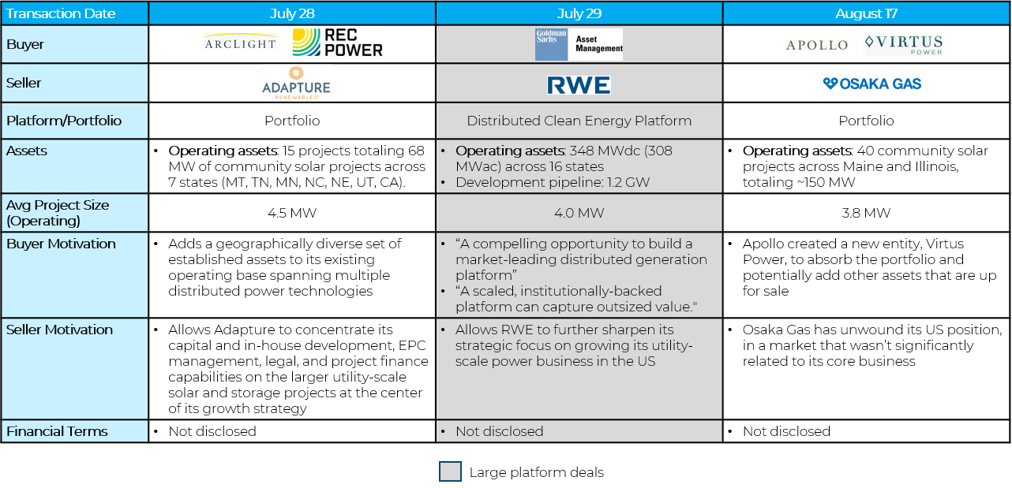
Figure 1 highlights six transactions announced in July and August 2026, presented in chronological order. The transactions consist of three platform acquisitions (shaded) and three portfolio acquisitions. The platform transactions represent the larger deals, led by MN8's acquisition of Greenbacker and Global Infrastructure Partners' acquisition of Summit Ridge.
Figure 1. Recent Transactions (July-August 2026, in chronological order)
Investor interest remains strong for operating projects with contracted cash flows. However, development projects without a line of site on COD, either through safe harboring or other means, have diminished in value in the aftermath of OBBBA.
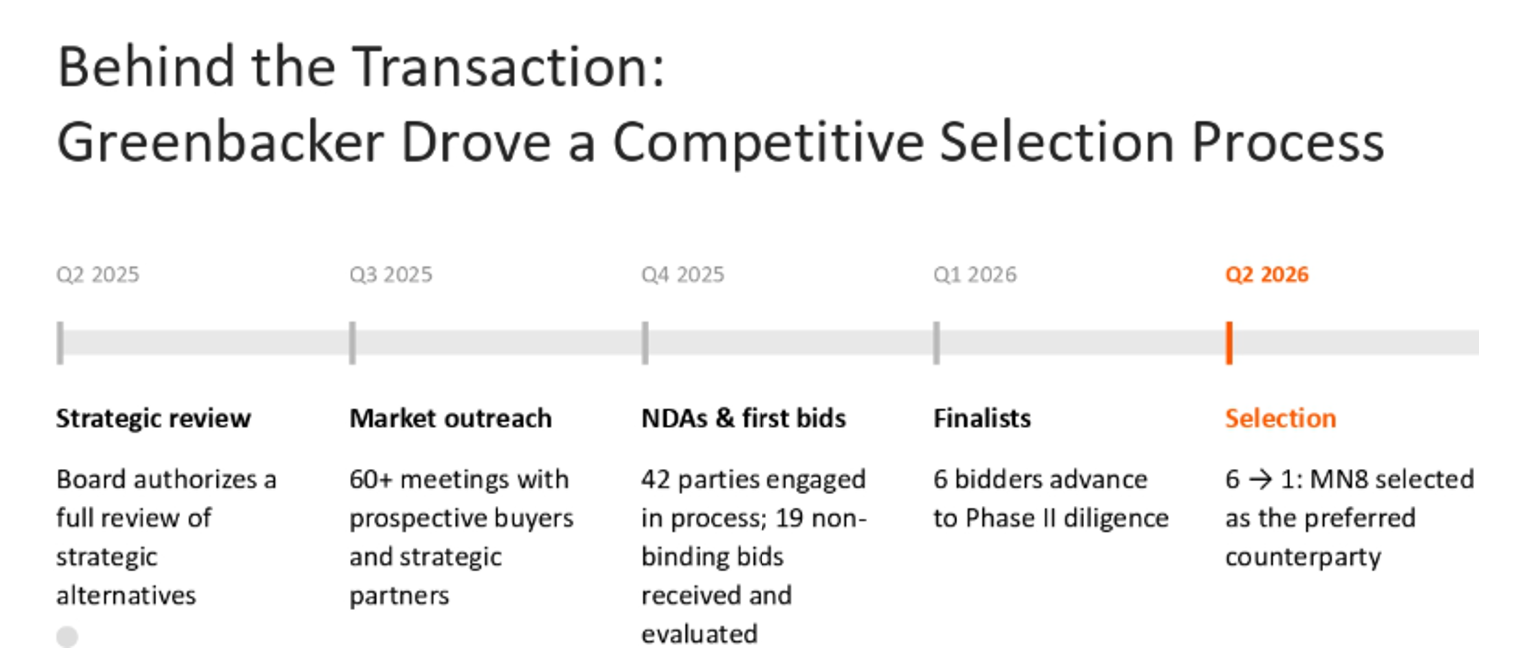
While there is significant seller interest at the moment, there also remains considerable buyer interest. Greenbacker’s sale process was highly competitive, with 42 engaged parties, including 19 bidders and six finalists (Figure 2). The breadth of participation suggests that the ultimate valuation represented a market-clearing price established through a robust competitive process rather than an opportunistic acquisition resulting from limited buyer interest.
Figure 2. Greenbacker's Sale Process
Leading Players
The impact of the transactions shown in Figure 1 becomes clearer when viewed in the context of operating asset ownership.
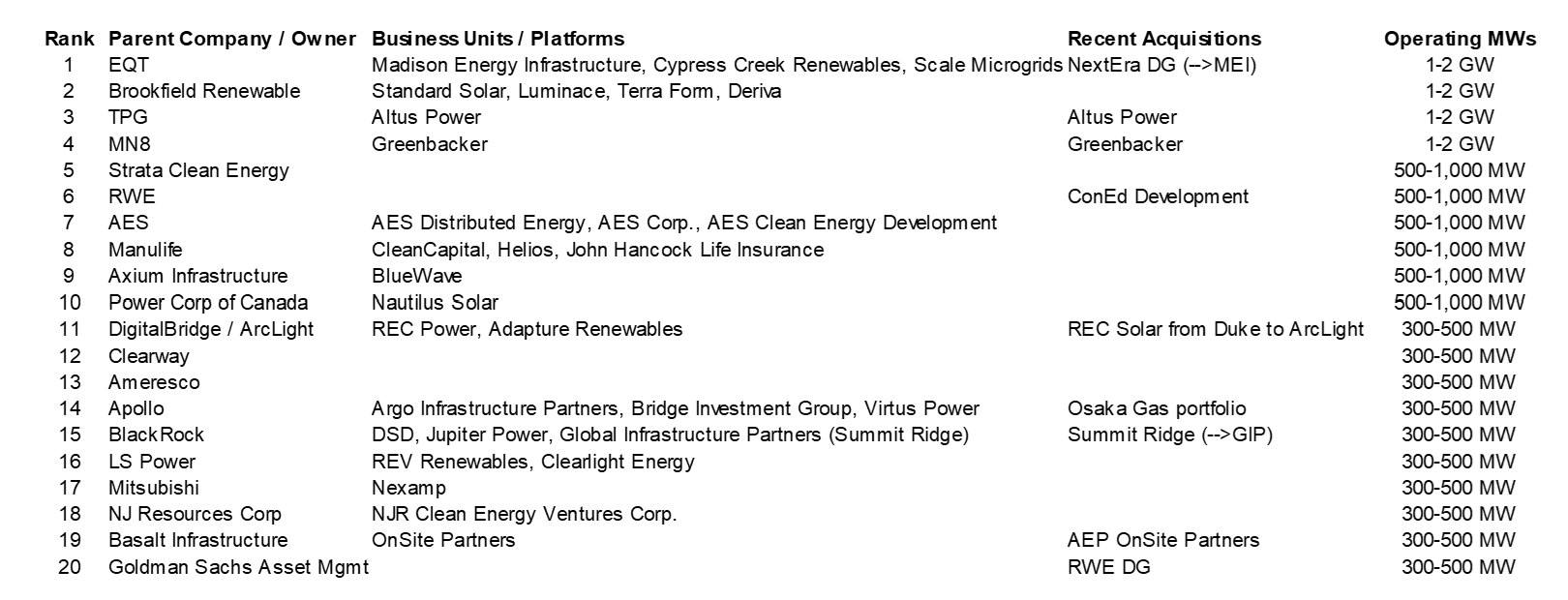
Figure 3 presents estimated rankings of companies based on the total operating capacity of solar and storage projects ranging from 500 kW to 20 MW. Projects within this size range are generally interconnected to the distribution grid or located behind the customer meter and therefore provide a useful proxy for the DG market.
Consolidation has also created increasingly complex ownership structures, with several large parent companies controlling multiple DG platforms. EQT, for example, ranks as the largest owner by this measure and holds majority ownership stakes in three separate platforms (Madison Energy Infrastructure, Cypress Creek Renewables and Scale Microgrids), while Brookfield owns four (Standard Solar, Luminace, Terra Form and Deriva). As a result, looking only at individual platform names can understate the scale and market position of the ultimate parent companies.
Figure 3. Leading Asset Owners – 500 kW-20 MW Solar and Storage Operating Projects
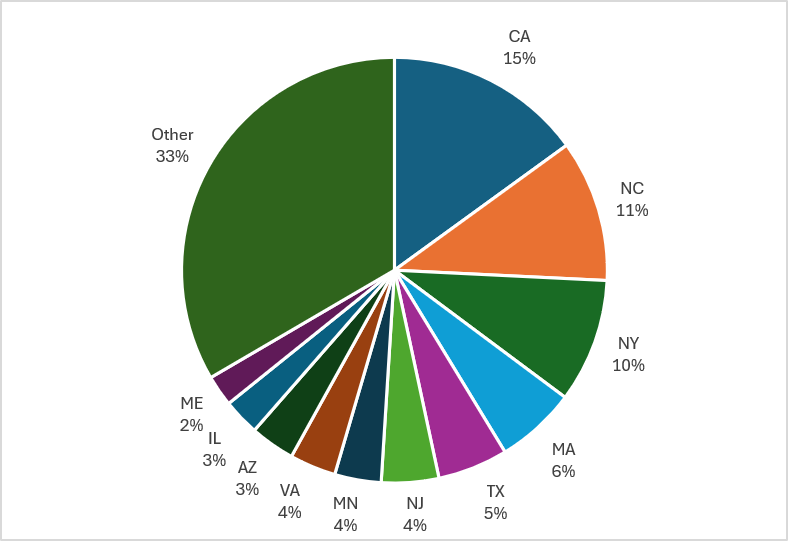
The assets owned by these companies are spread across the United States, reflecting the state-by-state development of the DG market (Figure 4). California remains the country's largest DG market, driven in large part by its early leadership in distributed solar; at one point, the state accounted for the vast majority of DG capacity being installed in the US, though the percentage has declined over time.
Several other states developed into major markets through distinct policy and regulatory frameworks. North Carolina became an important market through qualifying facility (QF) projects, many of which are in the 5 MW range. New York has been a leading market through its Value of Distributed Energy Resources (VDER) framework, while Massachusetts has supported sustained DG development through three successful programs spanning roughly 15 years: SREC I, SREC II and SMART.
Other notable markets include New Jersey, Minnesota, Illinois and Maine, each of which has supported substantial DG development through community solar or related programs.
Figure 4. Market Share by State, ~40 GW
Taken together, the recent transactions point to a DG market entering a new phase. The industry is moving away from a highly fragmented landscape of individual developers and asset owners toward a smaller group of increasingly scaled operators. Policy changes, tighter development economics and strategic portfolio repositioning are accelerating that transition. With numerous additional platforms and portfolios still on the market, the ownership rankings shown in Figure 3 are unlikely to remain static. The next round of transactions could further concentrate operating assets among a relatively small group of well-capitalized owners.
Andrew Kinross is a Director with Power Advisory and can be reached at akinross@poweradvisoryllc.com.